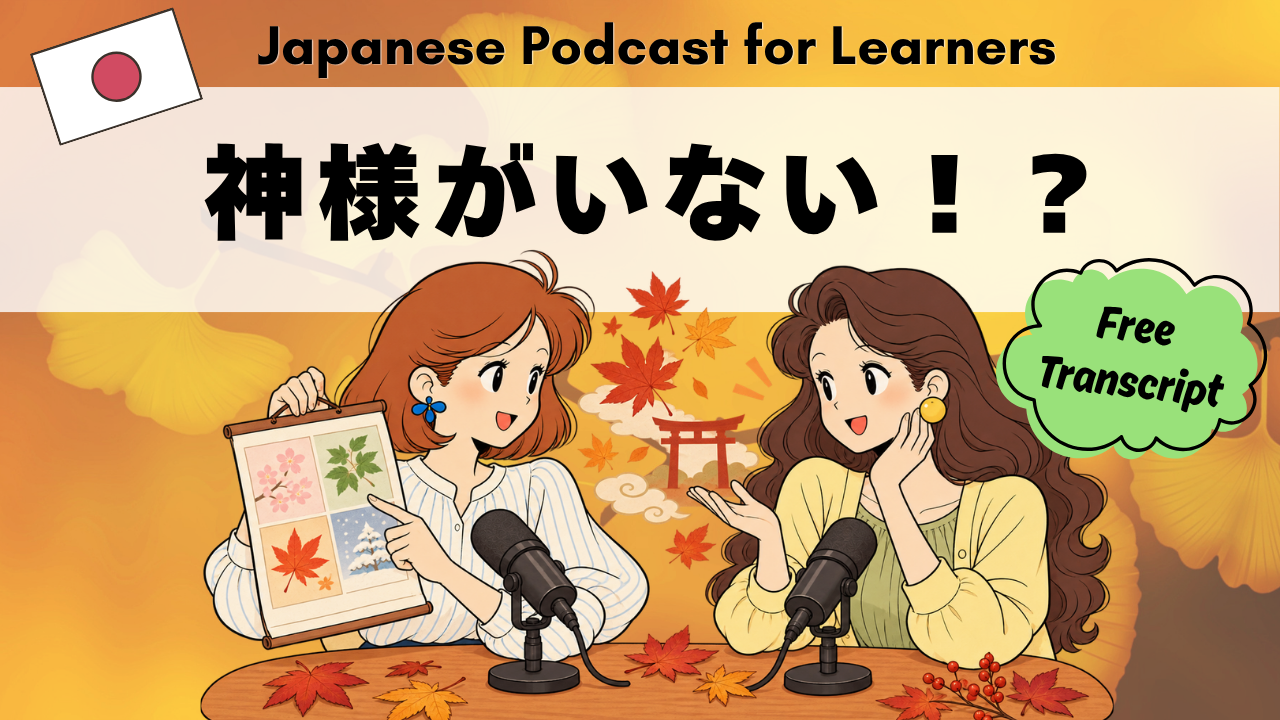
神無月ってなに?Why Are Japan's Gods Away in October?
October has an old Japanese name: Kannazuki. The kanji appear to mean 'the month without gods,' but where are the gods said to go? Misaki and Nozomi explore Japan's traditional month names, the famous Izumo legend, and the contrasting name Kamiarizuki.

What You’ll Learn
You will learn the twelve traditional Japanese month names, separate the Chinese-derived calendar system from Japan's traditional month names, and understand why their seasons do not exactly match today's calendar. You will also distinguish the uncertain origin of Kannazuki from the famous legend that the gods gather in Izumo, compare jinja, taisha, and yashiro, and see why enmusubi includes many kinds of connections rather than romance alone.
Transcript
October has another name
1. 10月には、もう一つ名前がある
October has another name
Misaki ノゾミ、もう10月だね。
English: Nozomi, it is already October.
Nozomi 早いね。北海道は朝と夜がもう寒いよ。
English: That was fast. The mornings and evenings are already cold here in Hokkaido.
Misaki ところで、10月には「神無月」という昔の名前があるの、知ってる?
English: By the way, did you know October has an old name, Kannazuki?
Nozomi 神無月かあ。聞いたことはあるけど、意味を説明してと言われたら、ちょっと困るかも。
English: Kannazuki… I have heard it, but I might struggle if someone asked me to explain it.
Misaki ということで始まりました、Late Night Japanese Chat。
English: And with that, welcome to Late Night Japanese Chat.
Misaki この番組では、日本語を勉強しているみなさんと、日本の言葉や文化、日常の小さな疑問について話しています。
English: In this podcast, we talk with Japanese learners about Japanese words, culture, and little questions from daily life.
Nozomi 最近、本当にいろいろな話をしているよね。
English: We really have been talking about all kinds of things lately.
Misaki この番組を作っているHaruが、いろいろなことに興味があるみたいだからね。
English: It seems Haru, who makes this podcast, is interested in all kinds of things.
Nozomi それで今日は神無月? ちょっとマニアックな言葉が来たね。
English: And today it is Kannazuki? That is a slightly niche word.
Misaki 私たち、ミサキと……。
English: We are Misaki and…
Nozomi ノゾミがお届けします。今夜も楽しく話していきましょう。
English: Nozomi, bringing you tonight's episode. Let us enjoy the conversation.
From Mutsuki to Shiwasu
2. 睦月から師走まで
From Mutsuki to Shiwasu
Misaki 日本には、一月、二月という数字の呼び方とは別に、昔の月名があるよね。
English: In Japan, besides numbered names such as ichigatsu and nigatsu, there are traditional names for the months.
Nozomi 一月は睦月、二月は如月。三月は弥生だね。
English: January is Mutsuki, February is Kisaragi, and March is Yayoi.
Misaki 四月からは、卯月、皐月、水無月、文月、葉月、長月。
English: From April, they are Uzuki, Satsuki, Minazuki, Fumizuki, Hazuki, and Nagatsuki.
Nozomi そして、神無月、霜月、師走。一度に聞くと呪文みたい。
English: Then Kannazuki, Shimotsuki, and Shiwasu. Hearing them all at once is like hearing a spell.
Misaki 睦月は、家族や親戚が集まって仲良くする月。師走は、先生やお坊さんまで走るほど忙しい月、という説明をよく聞くね。
English: Mutsuki is often explained as the month when families and relatives gather in harmony. Shiwasu is often said to be so busy that even teachers or Buddhist priests run.
Nozomi でも、それが絶対に正しい語源というわけではないんだよね。
English: But those are not necessarily the one proven origin of each word.
Misaki そう。昔の月名は、由来にいろいろな説があるものが多いよ。
English: Right. Many traditional month names have several theories about their origins.
Nozomi 如月は、寒いから衣をさらに着る「衣更着」。弥生は、草木がだんだん生い茂る月、という説明もあるよね。
English: Kisaragi is sometimes explained as “wearing even more clothing” because it is cold. Yayoi is said to be the month when plants increasingly grow.
Misaki 葉月は葉が落ちる月、霜月は霜が降りる月。名前から昔の季節が見えてくるのも面白いね。
English: Hazuki is said to be the month when leaves fall, and Shimotsuki the month when frost appears. It is interesting how the old seasons appear inside the names.
Where did the calendar come from?
3. 暦はどこから来た?
Where did the calendar come from?
Misaki では、この昔の暦は、最初から日本にあったのかな。
English: So was this old calendar originally created in Japan?
Nozomi 暦の仕組みは、古代の中国から伝わったんだよね。
English: The calendar system came from ancient China, right?
Misaki うん。6世紀から7世紀ごろに、朝鮮半島を通って日本へ伝わったとされているよ。
English: Yes. It is thought to have reached Japan through the Korean Peninsula around the sixth or seventh century.
Nozomi じゃあ、睦月や神無月も中国語なの?
English: Then are Mutsuki and Kannazuki Chinese words too?
Misaki そこは分けて考えよう。暦の仕組みは中国から伝わったけど、睦月や神無月は、日本で使われてきた和風の月名なの。
English: We should separate those two things. The calendar system came from China, but names such as Mutsuki and Kannazuki are traditional Japanese month names.
Nozomi 仕組みと名前は、同じ出身ではないんだね。
English: So the system and the names do not come from the same place.
Misaki それに昔の暦は今のカレンダーと違うから、季節が一か月から二か月ほどずれることもあるよ。
English: Also, because the old calendar differs from today's calendar, the season may be shifted by about one or two months.
Nozomi 昔の暦は、月の満ち欠けを使って一か月を決めて、季節とのずれは「うるう月」を入れて調整していたんだよね。
English: The old calendar used the phases of the moon to set each month and added a leap month to adjust the seasons.
Misaki そう。だから、昔の10月と、今のカレンダーの10月は、ぴったり同じ時期ではないの。
English: Right. That is why the old tenth month and October on today's calendar are not exactly the same period.
God, none, month?
4. 神・無・月?
God, none, month?
Misaki では、今日の主役、神無月を漢字で見てみよう。
English: Now let us look at today's main word, Kannazuki, through its kanji.
Nozomi 「神」は神様。「無」は、ない。「月」は月。
English: Kami means a god, na is written with the character meaning none, and tsuki means month.
Misaki 今の漢字の意味でそのまま読むと、「神様がいない月」に見えるね。
English: If we read the kanji using their modern meanings, it looks like “the month without gods.”
Nozomi 神様、全員どこへ行ったの?
English: Where did all the gods go?
Misaki その前に一つ注意。これが本当の語源だと決まっているわけではないよ。
English: Before answering, one caution: this has not been proven to be the true origin of the word.
Nozomi また諸説あります、だね。
English: Another case of “there are several theories,” then.
Misaki 昔の「な」は今の「の」と同じ働きで、「神の月」という意味だった、という説もあるの。
English: One theory says the old sound na worked like the modern particle no, so the name meant “the month of the gods.”
Nozomi そういえば六月の「水無月」も、漢字だけ見ると「水がない月」に見えるね。
English: Come to think of it, Minazuki, the old name for June, also looks like “the month without water” if we only read the kanji.
Misaki 水無月も、「水の月」という説明があるよ。今の漢字の意味だけで、昔の言葉を決めつけないほうがいいんだね。
English: Minazuki is also explained as “the month of water.” We should not decide the meaning of an old word only from the modern meanings of its kanji.
Nozomi でも、「神様がいない月」にも有名な話があるんでしょう?
English: But there is also a famous story about “the month without gods,” right?
The gods are meeting in Izumo
5. 神様は出雲で会議中
The gods are meeting in Izumo
Misaki 有名な言い伝えでは、全国の神様が年に一度、旧暦の10月に出雲へ集まるとされているよ。
English: In a famous legend, gods from around the country are said to gather in Izumo once a year during the tenth month of the old calendar.
Nozomi 出雲は、島根県にある出雲大社の出雲だね。
English: Izumo is the place in Shimane Prefecture where Izumo Taisha is located.
Misaki そこで神様たちは、人と人との縁などについて話し合うといわれているの。この会議を「神議」と呼ぶよ。
English: The gods are said to discuss people's connections and other matters there. This divine meeting is called kamihakari.
Nozomi 神様の会議かあ。参加者は何人ぐらいなんだろう。
English: A meeting of gods… I wonder how many participants there are.
Misaki 日本には「八百万の神」という言葉があるでしょう。数え切れないほど多い神様、という意味だよ。
English: Japanese has the expression yaoyorozu no kami, meaning gods too numerous to count.
Nozomi それは大きな会議室が必要だね。
English: They would need a very large meeting room.
Misaki 自然や身近なものにも神様を感じる考え方が、日本には昔からあるんだよ。
English: Japan has long had a way of thinking that senses the presence of gods in nature and familiar things.
Nozomi 山や川、大きな木や岩にも神様を感じる。だから「八百万」は、八百万ぴったりという意味じゃないんだね。
English: People may sense gods in mountains, rivers, large trees, and rocks. So yaoyorozu does not mean exactly eight million.
Misaki うん。「数え切れないほどたくさん」という意味で使われているよ。
English: Right. It is used to mean “too many to count.”
In Izumo, it is Kamiarizuki
6. 出雲では神在月
In Izumo, it is Kamiarizuki
Misaki 神様が出雲へ行くから、ほかの土地では神様が留守になる。それが神無月の有名な説明だね。
English: The gods go to Izumo, leaving other places without them. That is the famous explanation of Kannazuki.
Nozomi でも、出雲には神様がたくさんいるよね。出雲でも神無月なの?
English: But Izumo is full of gods then. Is it still called Kannazuki there?
Misaki 出雲地方では、反対に「神在月」と呼ばれるよ。
English: In the Izumo region, it is instead called Kamiarizuki.
Nozomi 神様がいない月ではなくて、神様がいる月。分かりやすい!
English: Not the month without gods, but the month with gods. That is easy to understand!
Nozomi ところで、「出雲大社」の「大社」って、「神社」とは違うの?
English: By the way, is the taisha in Izumo Taisha different from a jinja, or shrine?
Misaki 「神社」「大社」「神宮」などは、神社の名前につく称号で、「社号」と呼ばれるよ。
English: Jinja, taisha, and jingu are titles attached to shrine names. They are called shago.
Nozomi 大社は、大きな神社という意味?
English: Does taisha simply mean a large shrine?
Misaki 今は「大社」と呼ばれる神社がいくつかあるけど、もともと大社という社号は、特に出雲大社を表すものとして使われてきたの。
English: Today several shrines use the title taisha, but originally this title was used particularly for Izumo Taisha.
Nozomi じゃあ、「社」は? 出雲大社は、正式には「いづもおおやしろ」とも読むんでしょう?
English: Then what does yashiro mean? The formal reading of Izumo Taisha is also Izumo Oyashiro, right?
Misaki そう。一般的には「いづもたいしゃ」、正式には「いづもおおやしろ」。「社」は、もともと神様を祭るために清めた場所や、神様を祭る建物を表す言葉だよ。
English: Right. The common reading is Izumo Taisha, while the formal reading is Izumo Oyashiro. Yashiro originally referred to a purified place or building for worshipping a deity.
Nozomi 一つの名前の中に、普通の読み方と正式な読み方があるんだ。日本語らしいね。
English: One name has both a common reading and a formal one. That feels very Japanese.
Misaki その出雲大社では、神様を迎える神事や、神様が集まる期間の祭りが今も行われているよ。
English: Izumo Taisha still holds rituals to welcome the gods and festivals during the period when they are said to gather.
Nozomi 昔話だけじゃなくて、今も行事として続いているんだね。
English: So it is not only an old story. It continues today as a living tradition.
Enmusubi is not only about romance
7. 縁結びは恋愛だけじゃない
Enmusubi is not only about romance
Misaki 神様たちが相談するといわれている「縁」も、今日の大事な言葉だよ。
English: En, the connections the gods are said to discuss, is another important word today.
Nozomi 出雲大社は、縁結びで有名だよね。恋人がほしい人がお参りするところ?
English: Izumo Taisha is famous for enmusubi. Is it a place people visit when they want a romantic partner?
Misaki それだけじゃないよ。「縁」は、人と人だけではなく、人と仕事などをつなぐ関係も表すの。
English: It is not only that. En can describe connections not only between people, but also between a person and work or other parts of life.
Nozomi 友達、家族、仕事。いろいろな出会いが縁なんだ。
English: Friends, family, and work. Many kinds of encounters can be en.
Misaki 「縁結び」の「結ぶ」は、ひもを結ぶ時にも使う言葉だよ。別々だったものを、つなぐイメージだね。
English: The musubu in enmusubi is also the verb used for tying a string. It gives the image of connecting things that were separate.
Nozomi 人との縁を結ぶ、仕事との縁を結ぶ。形がないものも「結ぶ」んだね。
English: You form a bond with a person or a connection with work. Even something without a physical shape can be tied together.
Misaki 神様たちは、誰と誰を出会わせるか、さまざまな縁について話し合うのだそうだよ。
English: The gods are said to discuss many kinds of connections, including who will meet whom.
Nozomi じゃあ、私たちがこの番組で出会ったのも、会議で決まったのかな。
English: Then perhaps our meeting through this podcast was decided at that meeting too.
Misaki 本当かどうかは分からないけど、そう考えると少し面白いね。
English: I do not know whether that is true, but it is interesting to imagine.
The gods who remain inside words
8. 言葉の中に残る神様
The gods who remain inside words
Misaki 日本では、自分は無宗教だと考える人も多いといわれるよね。
English: In Japan, many people are said to think of themselves as having no particular religion.
Nozomi 普段は神様を意識しなくても、月の名前や季節の行事には、昔の物語が残っているんだね。
English: Even if people do not think about gods in daily life, old stories remain in month names and seasonal customs.
Misaki 今日の話は、宗教を信じてほしいという話ではなく、日本にはこんな言い伝えがある、という文化の話です。
English: Today's episode is not asking anyone to believe in a religion. It is a cultural story about a tradition told in Japan.
Misaki 今日覚えてほしいのは三つ。10月の昔の名前は神無月。出雲では神在月。そして、神様が縁について話し合うという言い伝えがあること。
English: Here are the three things to remember: October's traditional name is Kannazuki; in Izumo it is Kamiarizuki; and there is a legend that the gods gather to discuss people's connections.
Nozomi これだけ覚えたら、神無月の話はばっちりだね。
English: If you remember those three things, you have the main story of Kannazuki.
Nozomi そういえば今度、Haruが実際に出雲大社へ行ったときの話もするんだって。
English: By the way, I heard Haru is going to tell us sometime about actually visiting Izumo Taisha.
Misaki 生姜糖とか、出雲そばとか、食べ物の話もあるみたいだよ。
English: It sounds like there will also be food stories about ginger candy and Izumo soba.
Nozomi やった。そっちは食べ物の回だ。
English: Yes! That one is a food episode.
Misaki みなさんの国では、10月を別の名前で呼ぶことがありますか? ほかの月の特別な呼び方でも大丈夫です。ぜひコメントで教えてください。
English: In your country, is October ever called by another name? A special name for another month is welcome too. Please tell us in the comments.
Nozomi 今日のトランスクリプトは、概要欄のリンクから読めます。聞き取れなかった言葉も、文字で確認してみてね。
English: You can read today's transcript through the link in the description. Use it to check any words you could not catch by listening.
Misaki 今日の話が面白かったら、Goodボタンとチャンネル登録で応援してもらえたら嬉しいです。
English: If you enjoyed today's story, we would be happy if you supported us with the Like button and a subscription.
Nozomi また聞いてくれたら嬉しいです。それでは、おやすみなさい。
English: We would be happy if you listened again. Good night.
Vocabulary
Each word includes the original line from the transcript and one extra example. Use “See in transcript” to jump back to the conversation.
神無月the traditional Japanese name for the tenth lunar month
FROM THE TRANSCRIPT
ところで、10月には「神無月」という昔の名前があるの、知ってる?
EXAMPLE
古い日記の日付に、神無月と書かれていました。
Kannazuki was written in the date of an old diary.
神在月Izumo's name for the month when the gods are said to gather there
FROM THE TRANSCRIPT
出雲地方では、反対に「神在月」と呼ばれるよ。
EXAMPLE
神在月には、出雲で特別な行事があります。
Special events are held in Izumo during Kamiarizuki.
言い伝えa legend or tradition passed down over time
FROM THE TRANSCRIPT
有名な言い伝えでは、全国の神様が年に一度、旧暦の10月に出雲へ集まるとされているよ。
EXAMPLE
この湖には、龍にまつわる言い伝えがあります。
This lake has a legend connected to a dragon.
八百万の神countless gods
FROM THE TRANSCRIPT
日本には「八百万の神」という言葉があるでしょう。数え切れないほど多い神様、という意味だよ。
EXAMPLE
昔の人は、山や川にも神様を感じました。
People in the past sensed the presence of gods in mountains and rivers too.
縁結びthe forming of meaningful connections or bonds
FROM THE TRANSCRIPT
出雲大社は、縁結びで有名だよね。恋人がほしい人がお参りするところ?
EXAMPLE
新しい仕事との出会いも、一つの縁結びかもしれません。
Finding a new job may also be one kind of meaningful connection.
大社a shrine title; historically associated especially with Izumo Taisha
FROM THE TRANSCRIPT
出雲は、島根県にある出雲大社の出雲だね。
EXAMPLE
出雲大社には、一般的な読み方と正式な読み方があります。
Izumo Taisha has both a common reading and a formal reading.
Cultural Notes
The calendar system and the month names have different histories. Japan's early lunisolar calendar system came from ancient China through the Korean Peninsula around the sixth to seventh centuries. Names such as Mutsuki and Kannazuki are traditional Japanese month names.
Kannazuki does not have one confirmed etymology. The kanji can be read today as 'god,' 'none,' and 'month.' Another explanation treats na as an old possessive particle like modern no, giving the meaning 'month of the gods.' The episode presents the Izumo story as a famous legend rather than a proven origin.
Taisha and yashiro reveal another layer of the shrine's name. Jinja, taisha, and jingu are titles attached to shrine names. Taisha was historically used especially for Izumo Taisha. The shrine explains that Izumo Taisha is the common reading, while Izumo Oyashiro is the formal reading. Yashiro refers to a place or building where a deity is worshipped. Enmusubi at Izumo includes family, friendship, work, and other connections, not romance alone.
Haru’s Note
I do not usually think about gods in daily life, but old stories still remain inside familiar Japanese words and seasonal customs. This episode introduces the legend as culture rather than asking anyone to accept it as religious fact.
普段の生活で神様を意識しなくても、日本語の言葉や季節の行事には昔の物語が残っています。この回では、宗教的な事実としてではなく、日本に伝わる文化として神無月を紹介します。

コメント