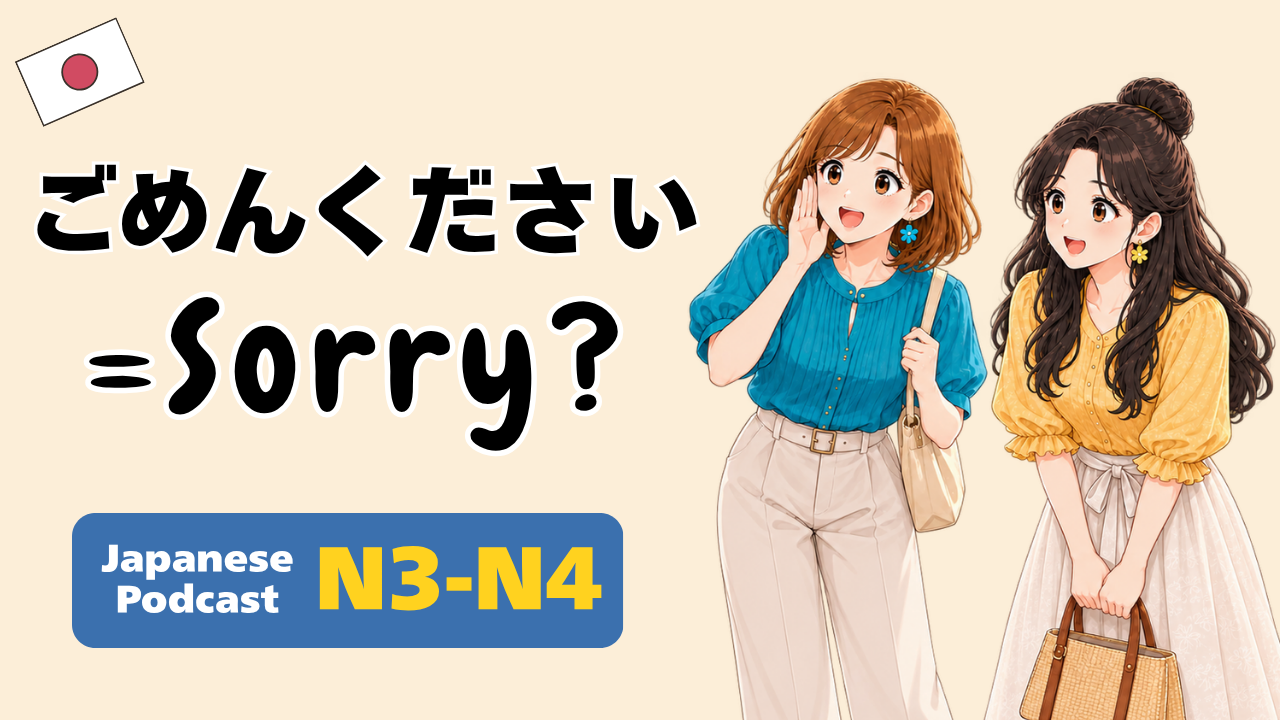
ごめんください?Why Say It Is It an Apology?
Why call ごめんください at a doorway when you have done nothing wrong? Misaki and Nozomi start with that everyday puzzle and follow the kanji 御免 toward two meanings of 許す: allowing someone to do something and forgiving a mistake. A borrowed book, a driving licence, and an unwelcome early start help connect three familiar expressions containing ごめん.

- What You’ll Learn
- Transcript
- What do you say in a shop where no one is there?
- How are gomen and a driving licence connected?
- Borrowing a book and staining it
- At the door, you hope to hear come in
- What do you want forgiven with gomen nasai?
- Listen to what follows a short gomen
- What does sore wa gomen da ask to be excused from?
- Three expressions with gomen come together
- Vocabulary
- Cultural Notes
- Haru’s Note
What You’ll Learn
You will learn why ごめんください is not simply an apology when used at a doorway. The example of borrowing a book and then accidentally staining it makes the difference between permission and forgiveness clear. You will also see why an apology can concern a future event, as in ごめん、明日は行けない, so before and after alone do not separate the meanings. Finally, you will compare ごめんなさい with the much stronger refusal それはごめんだ and understand why related expressions cannot always replace one another.
Transcript
What do you say in a shop where no one is there?
1. 誰もいないお店で、何と言う?
What do you say in a shop where no one is there?
Nozomi ねえ、ミサキ。お店に入って、誰もいなかったら何て言う?
English: Hey, Misaki. If you enter a shop and no one is there, what do you say?
Misaki 「ごめんくださーい!」じゃない?
English: Wouldn’t you call out, “Gomen kudasai!”?
Nozomi やっぱりそうなんだ。私は別の言い方をするかも。
English: I thought you might say that. I might use something else.
Misaki え、何? まあでも正直、最近はあんまり聞かないかも。
English: Oh, what would you say? Though honestly, I do not hear it very often these days.
Nozomi だよね。私は「すみませーん!」って言うと思う。
English: Right? I think I would call out, “Sumimasen!”
Misaki ああ、私も実際にはそうかも。でも、日本語の教科書には「ごめんください」って載っているみたいだよ。
English: Actually, I might too. But it seems Japanese textbooks teach “gomen kudasai.”
Nozomi そうなんだ! ていうか、「ごめんください」って何だろう。謝ってる?
English: Really? But what does “gomen kudasai” actually mean? Are we apologizing?
Misaki お店に入っただけなのにね。今夜は「ごめんください」「ごめんなさい」、それから「それはごめんだ」の三つを見ていきます。
English: When all we did was walk into a shop! Tonight, we will look at three expressions: “gomen kudasai,” “gomen nasai,” and “sore wa gomen da.”
Nozomi 同じ「ごめん」なのに、ずいぶん違うね。どうつながっているのか、一緒に考えましょう。
English: They all contain “gomen,” but they sound so different. Let’s find out how they connect.
Misaki ということで始まりました、Late Night Japanese Chat。私たち、ミサキと……
English: And with that, welcome to Late Night Japanese Chat. We are Misaki and…
Nozomi ノゾミがお届けします。今夜も楽しく話していきましょう。
English: Nozomi. Let’s enjoy another conversation tonight.
How are gomen and a driving licence connected?
2. 「ごめん」と運転免許がつながる?
How are gomen and a driving licence connected?
Misaki 「ごめん」を漢字で書くと「御免」なんだよね。後ろの「免」は、運転の免許と同じ字だよ。
English: “Gomen” can be written 御免. The second character, 免, is the same one in “menkyo,” as in a driving licence.
Nozomi 免許って、車を運転してもいいということだよね。車に謝っているんじゃないし。
English: A licence means you are allowed to drive a car. You are not apologizing to the car!
Misaki そこから考えると分かりやすいね。昔の「御免」には「してもいいですよ」という意味があったんだって。
English: That is a helpful way to think about it. Older “gomen” could mean that you were allowed to do something.
Nozomi あ、じゃあ「ごめんください」は、「してもいいですよ」って言ってもらいたいの? 謝るだけじゃなかったんだ。
English: Oh, so with “gomen kudasai,” you want someone to say you may do something? It was not only about apologizing.
Misaki うん。「許しをください」に近いんだね。初めに考えた「謝ってる?」も、半分は近かった。
English: Yes, it is close to asking to be allowed. Our first thought about apologizing was partly on the right track.
Nozomi でも「許してください」って、やっぱり悪いことをした時の言葉に聞こえない?
English: But does “please forgive me” not still sound like something you say after doing something wrong?
Misaki ああ、私も今そっちを考えてた。同じ「許す」でも、二つを分けるとよさそう。
English: Oh, that was what I was thinking of too. It helps to separate two meanings of “yurusu.”
Nozomi 「してもいい」と「悪いことをした」は違うもんね。何か毎日の生活の例で考えてみよう。
English: Being allowed to do something and having done something wrong are different. Let’s try an everyday example.
Borrowing a book and staining it
3. 本を借りる時と、汚した時
Borrowing a book and staining it
Misaki たとえば、ノゾミの本を読みたい時。私が「これ、借りてもいい?」って聞きます。
English: Suppose I want to read your book. I ask, “May I borrow this?”
Nozomi 私が「いいよ」って言う。これが一つ目の「許す」だね。何かをしてもいい、と言うこと。
English: I say, “Sure.” That is the first meaning of “yurusu”: saying someone may do something.
Misaki じゃあ、借りた本にお茶をこぼして、汚してしまったら? 「ごめんね」と謝るよね。
English: Now, what if I spill tea on the book I borrowed and stain it? I would apologize.
Nozomi そこで私が許すのは、失敗した相手を責めないこと。「あなたが悪い」と何度も言わない、という意味だね。
English: If I forgive you then, I stop holding that mistake against you. I do not keep blaming you for it.
Misaki 本を汚してもいいと言ったんじゃないね。起きてしまったことを許すんだ。
English: You are not saying I may stain the book. You are forgiving something that has happened.
Nozomi 「許す」を全部「してもいい」にしたら、次もお茶をこぼしていいことになっちゃう。
English: If every “yurusu” meant permission, you would be allowed to spill tea again next time.
Misaki それは困るね。 英語なら、一つ目は allow、二つ目は forgive に近いんだ。
English: That would be a problem! In English, the first is close to “allow,” and the second to “forgive.”
Nozomi 同じ「許す」でも違うんだね。じゃあ入口の「ごめんください」は、どっちだろう?
English: So the same Japanese word covers different meanings. Which one helps us understand “gomen kudasai” at the door?
At the door, you hope to hear come in
4. 入口でほしいのは「どうぞ」
At the door, you hope to hear come in
Misaki 人の家へ行って、入口で「ごめんください」。まだ中へ入っていない時だね。
English: You visit someone’s home and call “gomen kudasai” at the entrance, before going inside.
Nozomi 何かを壊したんじゃないし、謝るほうじゃなさそう。「入ってもいいですか」に近いね。
English: You have not broken anything, so this does not seem to be the apology meaning. It is closer to asking whether you may come in.
Misaki そう。「入ることや声をかけることを許してください」と考えると、つながるね。
English: Yes. Thinking of it as asking to be allowed to enter or call on someone helps connect the meanings.
Nozomi 「ください」の前って、「お水をください」みたいに物が来ると思ってた。ここでは「許し」なんだ。
English: I was picturing something physical before “kudasai,” like asking for water. Here, what you ask for is permission.
Misaki 相手から「どうぞ」と言ってもらいたいんだね。「何を謝っているの?」という最初の疑問が、少し変わった。
English: You want the other person to invite you in. Our first question about what we were apologizing for has changed a little.
Nozomi 「何をしてもいいって言ってほしいの?」って考えればよかったんだ。
English: We could have asked, “What do you want to be allowed to do?”
Misaki もちろん、今は一つの挨拶だから、毎回そこまで考えて言うんじゃないけどね。
English: Of course, it is a set greeting now. People do not think through all of that every time they say it.
Nozomi じゃあ「ごめんなさい」のほうは、本にお茶をこぼした時の「許す」とつながりそうだね。
English: Then “gomen nasai” seems connected to forgiving the spilled tea on the book.
What do you want forgiven with gomen nasai?
5. 「ごめんなさい」で許してほしいこと
What do you want forgiven with gomen nasai?
Misaki 「本を汚して、ごめんなさい」。こちらは、自分がした悪いことや失敗を許してほしいんだね。
English: “I am sorry I stained your book.” Here, you want forgiveness for something wrong you did or a mistake you made.
Nozomi 「ごめんください」と音が似ているだけじゃなかったんだ。「許してほしい」は同じでも、中身が違う。
English: So it is not just that it sounds like “gomen kudasai.” Both ask to be allowed or forgiven, but for different things.
Misaki 私も「ください」と「なさい」の違いばかり見てた。前の「ごめん」を見ると、同じ家族だと分かるね。
English: I was focusing only on the different endings. Looking at “gomen” shows us that they belong to the same family.
Nozomi でも、本を汚したあとで「ごめんください」と言ったら、今の会話では変に聞こえるよね。
English: But saying “gomen kudasai” after staining the book would sound odd in our conversation today.
Misaki 入口から誰か来たのかと思いそう。つながりがあっても、自由に入れ替えることはできないね。
English: I might think someone had arrived at the door. Being related does not mean we can freely swap them.
Nozomi 私たちは「ごめん」を謝る時によく聞くから、入口でも謝っているように感じたのか。
English: We so often hear “gomen” in apologies that we felt it must be an apology at the entrance too.
Misaki そういえば、友達には「ごめんなさい」より「ごめんね」って言うこともあるね。後ろを短くして。
English: With friends, we also sometimes use the shorter “gomen ne” rather than “gomen nasai.”
Nozomi 短い「ごめん」にも、今見つけた「許してほしい」が残っているんだね。
English: Even that short “gomen” still carries the wish to be forgiven that we have just found.
Listen to what follows a short gomen
6. 短い「ごめん」のあとを聞いてみる
Listen to what follows a short gomen
Misaki 「ごめん、待った?」って、友達に言うこともあるね。「ごめんなさい」と全部言わなくても伝わる。
English: We might say to a friend, “Sorry, have you been waiting?” We do not need the full “gomen nasai” to be understood.
Nozomi 待たせたことを謝っているんだね。短くても、何を許してほしいか分かる。
English: You are apologizing for keeping them waiting. Even in the short version, we know what you want forgiveness for.
Misaki じゃあ「ごめん、明日は行けない」なら? まだ明日になっていないけど、謝っているね。
English: What about “Sorry, I cannot come tomorrow”? Tomorrow has not happened yet, but it is still an apology.
Nozomi あ、「したあと」か「する前」かだけでは分けられないんだ。誘ってくれた相手に、行けなくてごめんと言っている。
English: Oh, so we cannot separate the meanings just by before and after. We are apologizing to the person who invited us because we cannot go.
Misaki 本の例だけだと、そこを間違えそうだったね。大事なのは、何を伝えているかなんだ。
English: The book example alone might have led us to that mistake. What matters is what the person is communicating.
Nozomi それなら、「毎日、朝の四時に起きよう」って言われて、「それはごめんだ!」は?
English: Then what if someone suggests getting up at four every morning, and you say, “Sore wa gomen da!”?
Misaki それは「嫌だ、したくない」だね。さっきの「ごめん、行けない」より、ずっと強く聞こえる。
English: That means “No, I do not want to!” It sounds much stronger than “Sorry, I cannot come.”
Nozomi 今度は謝ってないね。同じ「ごめん」が、どうして「嫌だ」になるんだろう。
English: Now it is not an apology. How can the same “gomen” mean that we do not want to do something?
What does sore wa gomen da ask to be excused from?
7. 「それはごめんだ」は、何を許してほしい?
What does sore wa gomen da ask to be excused from?
Misaki ここでは「私はそれをしなくてもいいことにして」と考えると、つながりが見えるね。
English: Here, thinking of it as “Let me not have to do that” helps us see the connection.
Nozomi 「朝の四時に起きないでいいことにして」か。 何かをする許しじゃなくて、しないほうなんだ。
English: “Let me off getting up at four,” then. It is not asking to do something, but to be excused from doing it.
Misaki 「御免」には、仕事などをしなくてよくなる意味もあるんだって。昔から、謝ること以外にも使っていたんだね。
English: “Gomen” can also refer to being released from a job or duty. It has covered much more than apologies.
Nozomi でも今「それはごめんだ」と言ったら、「嫌だ」という気持ちが強く伝わるよね。丁寧なお願いには聞こえない。
English: But today, “sore wa gomen da” strongly conveys that you do not want to do it. It does not sound like a polite request.
Misaki 元の意味を考えることと、今どう聞こえるかは別なんだね。「ご」がついているから丁寧、とも言えない。
English: Thinking about the older meaning is different from how it sounds now. Starting with “go” does not automatically make it polite either.
Nozomi 友達と笑って言うことはあっても、誘いを断る時に毎回使うのは、ちょっと強すぎるね。
English: We might joke with a friend, but using it every time we turn down an invitation would sound rather strong.
Misaki 私なら「ごめん、明日は行けない」にするな。同じ「ごめん」でも、あとに続く言葉で変わるね。
English: I would choose “Sorry, I cannot come tomorrow.” What follows changes how the same “gomen” comes across.
Nozomi 入口で呼ぶ時も、謝る時も、嫌だと言う時も。知っている言葉が、つながってきたね。
English: Calling at the door, apologizing, and saying no—the familiar expressions are starting to connect.
Three expressions with gomen come together
8. 三つの「ごめん」がつながった
Three expressions with gomen come together
Misaki 最初は、お店に入っただけなのに何を謝るの、って思った。でも「許す」には「してもいい」もあったんだね。
English: At first, we wondered what we were apologizing for just by entering a shop. But “yurusu” can also mean allowing someone to do something.
Nozomi 「ごめんください」は入る時の許し、「ごめんなさい」は失敗の許し。「それはごめんだ」は「したくない」。「しないでいいことにして」と考えると、これもつながるね。
English: “Gomen kudasai” connects to being allowed in, “gomen nasai” to forgiveness, and “sore wa gomen da” means “I do not want to.” Thinking of being excused from doing it helps connect this one too.
Misaki ただ今は、それぞれ決まった言い方だからね。お店で人を呼ぶだけなら「すみません」も使えるよ。
English: But today, each is an established expression. If you simply want someone’s attention in a shop, you can also use “sumimasen.”
Nozomi みなさんの言葉でも、「してもいい」と「失敗を許す」に同じ言葉を使いますか。違う言葉なら、それも知りたいです。
English: In your language, do you use the same word for giving permission and forgiving a mistake? We would love to hear if you use different words too.
Misaki それでは、今夜はこのへんで。今夜も聞いてくれてありがとうございます。
English: That is all for tonight. Thank you for listening this evening.
Nozomi 今日話したこととトランスクリプトは、サイトで公開しています。概要欄のリンクから、読んでみてくださいね。
English: What we talked about today and the transcript are available on our website. You can read them through the link in the description.
Misaki よかったらチャンネル登録して、また聞きに来てくださいね。おやすみなさい。
English: If you like, subscribe and come back to listen again. Good night.
Nozomi おやすみなさい。
English: Good night.
Vocabulary
Each word includes the original line from the transcript and one extra example. Use “See in transcript” to jump back to the conversation.
御免permission or being excused; also used in apologies and refusal
FROM THE TRANSCRIPT
「ごめん」を漢字で書くと「御免」なんだよね。後ろの「免」は、運転の免許と同じ字だよ。
EXAMPLE
「ごめん」は漢字で「御免」と書きます。
Gomen can be written with the kanji 御免.
許すto allow; to forgive
FROM THE TRANSCRIPT
ああ、私も今そっちを考えてた。同じ「許す」でも、二つを分けるとよさそう。
EXAMPLE
友達の失敗を許すことにしました。
I decided to forgive my friend's mistake.
免許a licence; official permission to do something
FROM THE TRANSCRIPT
免許って、車を運転してもいいということだよね。車に謝っているんじゃないし。
EXAMPLE
車を運転するには、免許が必要です。
You need a licence to drive a car.
ごめんくださいa greeting used to call out when visiting someone's home
FROM THE TRANSCRIPT
ああ、私も実際にはそうかも。でも、日本語の教科書には「ごめんください」って載っているみたいだよ。
EXAMPLE
入口で「ごめんください」と声をかけました。
I called out gomen kudasai at the entrance.
それはごめんだI do not want that; count me out—a strong refusal
FROM THE TRANSCRIPT
お店に入っただけなのにね。今夜は「ごめんください」「ごめんなさい」、それから「それはごめんだ」の三つを見ていきます。
EXAMPLE
毎日、朝の四時に起きるの? それはごめんだ。
Get up at four every morning? Count me out.
Cultural Notes
Permission and forgiveness share a Japanese verb. 許す can mean allowing an action or forgiving a mistake. These are two relevant meanings, not a complete list of everything the verb can express. Borrowing a book is the permission example; forgiving someone who stained it does not give them permission to stain it again. An apology about tomorrow also shows why this is not simply a distinction between future and past actions.
A word's history helps explain a greeting without replacing its modern use. The older permission-related meaning of 御免 helps make sense of ごめんください at a doorway. In modern conversation it functions as an established greeting, and speakers do not need to consciously request permission each time. Dictionaries also record other uses of the expression; this episode focuses on visiting. Its connection to ごめんなさい does not make the two interchangeable in the examples discussed.
Sore wa gomen da sounds stronger than an ordinary apology. それはごめんだ conveys a strong wish not to do or accept something. Thinking of being excused from doing it is a useful way to connect its meaning with other uses of 御免. This is a learning explanation, not a claim that one particular sentence was historically shortened into the expression. The friendly apology ごめん、明日は行けない communicates a different tone.
Haru’s Note
One familiar word can hide more than one meaning. Here, the key is to ask what someone wants to be allowed to do or forgiven for. The borrowed-book example helps separate those ideas, while the final refusal reminds us to listen to the whole expression rather than translate ごめん as sorry every time.
知っている言葉にも、違う意味が隠れていることがあります。何をしてもいいと言ってほしいのか、何を許してほしいのか。本の例で考えると、その違いが見えてきます。「ごめん」だけで決めず、あとに続く言葉も聞いてみてくださいね。


コメント