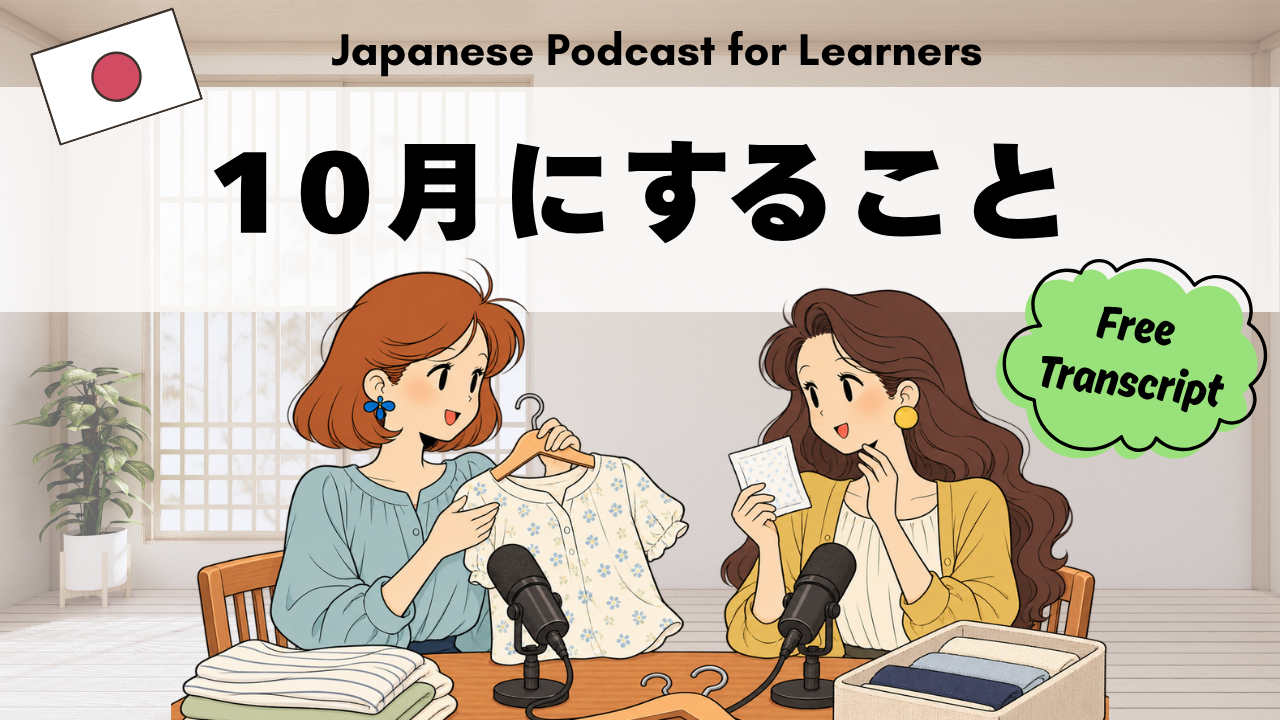
衣替えってなに?Why Do Japanese People Change Their Clothes in October?
Why do many people in Japan change their clothes around October? Misaki and Nozomi begin with 衣替え, the seasonal change from summer clothes to winter clothes, and follow the old word 衣 through court customs, kimono, school uniforms, and even the crisp coating around tempura.

- What You’ll Learn
- Transcript
- It is October—have you put away your summer clothes?
- Is koromo an old word for clothes?
- Did koromogae begin in the age of kimono?
- Clothing changes became more detailed in the Edo period
- School uniforms change together
- Why does tempura also have koromo?
- Preparing to welcome the next season
- Kimono in the past, Western clothes today
- Vocabulary
- Cultural Notes
- Haru’s Note
What You’ll Learn
You will learn what 衣 means and why it remains in words such as 衣服, 衣装, 衣食住, and 衣替え even though 服 is more common in everyday conversation. You will also trace 衣替え from seasonal clothing customs at the Heian-period imperial court to detailed changes of kimono in the Edo period and modern school uniform changes around June and October. Finally, you will see how the image of something covering the outside connects clothing with the 衣 around tempura and other fried foods.
Transcript
It is October—have you put away your summer clothes?
1. もう10月。夏服、しまった?
It is October—have you put away your summer clothes?
Misaki ねえ、ノゾミ。もう10月だね〜。
English: Hey, Nozomi. It is already October.
Nozomi ね〜。今年も、あっという間に終わりそう!
English: I know. This year feels like it will be over before we know it!
Nozomi 最近、寒くなってきたし、いい加減、夏服をしまわなきゃ。
English: It has been getting colder lately, so I really need to put my summer clothes away.
Misaki 私、昨日、やっと衣替えしたよ!
English: I finally changed over my wardrobe yesterday!
Nozomi さすが、ミサキ! 私も今度の休みにしようかな〜。
English: That is so like you, Misaki! Maybe I will do mine on my next day off.
Nozomi ていうか、今さらなんだけど……「衣」って何?
English: Actually, this may be a little late to ask, but what does “koromo” mean?
Nozomi なんで「服替え」って言わないんだろう?
English: Why do we not call it “fukugae,” changing clothes?
Misaki ノゾミ、すばらしい。それ、今日のテーマ!
English: Nozomi, wonderful. That is today’s topic!
Nozomi えっ、そうなの?
English: Really?
Misaki そう。今日は、「衣替え」の「衣」について話してみよう。
English: Yes. Today, let’s talk about the word “koromo” in “koromogae.”
Nozomi なんか急に、漢字の授業みたいになってきた。
English: This is suddenly starting to sound like a kanji lesson.
Misaki 大丈夫。途中で天ぷらも出てくるから。
English: Do not worry. Tempura will appear along the way.
Nozomi 天ぷら? 衣替えの話だよね?
English: Tempura? We are talking about changing clothes, right?
Misaki うん。どうつながるのか、一緒に見ていこう。
English: Yes. Let’s find out how they are connected.
Misaki ということで始まりました、Late Night Japanese Chat。私たち、ミサキと……
English: And with that, welcome to Late Night Japanese Chat. We are Misaki and…
Nozomi ノゾミがお届けします。今夜も楽しく話していきましょう。
English: Nozomi. Let’s enjoy another conversation tonight.
Is koromo an old word for clothes?
2. 「衣」は昔の「服」?
Is koromo an old word for clothes?
Misaki まず、「衣」は、体に着るもの。つまり、服を表す昔からの言葉なんだよ。
English: First, “koromo” means something worn on the body. In other words, it is an old word for clothing.
Nozomi じゃあ、意味は「服」と同じ?
English: So does it mean the same thing as “fuku,” clothes?
Misaki 近いね。でも、今の会話で「今日、新しい衣を買った」とは、あまり言わないよね。
English: They are close. But in conversation today, we do not usually say, “I bought a new koromo today.”
Nozomi たしかに。「新しい服を買った」って言う。
English: True. We would say, “I bought new clothes.”
Misaki 「衣」は、今も「衣服」「衣装」「衣替え」みたいな言葉の中に残っているんだね。
English: “Koromo,” or the character 衣, remains today in words such as ifuku, isho, and koromogae.
Nozomi あ、「衣食住」の「衣」も同じ字だ。
English: Oh, the “i” in ishokujū—clothing, food, and shelter—is the same character.
Misaki そうそう。着るもの、食べるもの、住むところ。生活に必要な三つだね。
English: Exactly. What we wear, what we eat, and where we live: three necessities of daily life.
Nozomi 古い言葉だけど、今もいろんな言葉の中で使われているんだね。
English: So it is an old word, but it is still used inside many words today.
Did koromogae begin in the age of kimono?
3. 衣替えは着物の時代から?
Did koromogae begin in the age of kimono?
Nozomi じゃあ、「衣替え」も、着物を着ていた時代からあるの?
English: Then has “koromogae” existed since the days when people wore kimono?
Misaki うん。平安時代には、宮中で季節に合わせて着るものを替える行事があったんだって。
English: Yes. In the Heian period, the imperial court had a custom of changing clothing with the seasons.
Nozomi 宮中って、天皇や貴族がいたところだよね。
English: The imperial court means the place where the emperor and nobles lived, right?
Misaki そう。当時は、今のカレンダーとは違うけど、春と秋の決まった日に衣を替えていたの。
English: Right. Their calendar differed from ours, but they changed clothing on set days in spring and autumn.
Nozomi 暑くなったから、今日は半袖にしよう、みたいに自分で決めるんじゃないんだ。
English: So it was not simply an individual decision like, “It is hot today, so I will wear short sleeves.”
Misaki うん。季節の行事として、みんなで替えていたんだね。
English: Right. People changed clothing together as a seasonal custom.
Nozomi 服を替えることが、行事になるの、おもしろいね。
English: It is interesting that changing clothes became an annual custom.
Clothing changes became more detailed in the Edo period
4. 江戸時代はもっと細かかった
Clothing changes became more detailed in the Edo period
Misaki それが江戸時代になると、着るものを替える時期が、もっと細かく決められたこともあったんだって。
English: In the Edo period, there were times when the dates for changing clothing were set in even more detail.
Nozomi 春と秋の二回だけじゃないの?
English: It was not just twice, in spring and autumn?
Misaki うん。裏地のある着物、裏地のない着物、綿を入れた着物みたいに、季節に合わせて替えていたんだよ。
English: No. People changed among lined kimono, unlined kimono, and padded kimono according to the season.
Nozomi 今みたいに、同じ服の上にセーターを一枚足す、という感じじゃないんだね。
English: So it was not quite like today, when we might simply add a sweater over the same clothes.
Misaki そうだね。着物そのものを、季節に合わせて替えていたんだね。
English: Right. The kimono itself was changed to match the season.
Nozomi それなら、「衣を替える」という言葉がぴったりだね。
English: In that case, the phrase “change one’s koromo” makes perfect sense.
School uniforms change together
5. 学校でみんな一斉に替える
School uniforms change together
Nozomi 昔は宮中や着物の話だけど、今も決まった日にみんなで替えることってある?
English: That explains the imperial court and kimono in the past, but do people still change clothing together on a set day today?
Misaki 学校の制服が分かりやすいね。日本では、一般的に6月ごろに夏服、10月ごろに冬服へ替える学校があるよ。
English: School uniforms are an easy example. In Japan, some schools generally change to summer uniforms around June and winter uniforms around October.
Nozomi あった、あった。ある日から、みんな一斉に半袖になったり、上着を着たりするの。
English: Yes, I remember. From a certain day, everyone would suddenly wear short sleeves or put on a jacket.
Misaki でも、季節の変わり目は、暑い日も寒い日もあるでしょう?
English: But during a change of season, there can be both hot and cold days, right?
Nozomi うん。冬服になったのに、昼は暑い日もあった。
English: Yes. There were days when it was warm at midday even after we changed to winter uniforms.
Misaki だから今は、夏服と冬服のどちらを着てもいい「移行期間」を作る学校もあるんだって。
English: That is why some schools now have a transition period when students may wear either the summer or winter uniform.
Nozomi 日付だけじゃなくて、自分の体や、その日の天気に合わせられるんだね。
English: So students can consider their own bodies and the weather, not only the date.
Why does tempura also have koromo?
6. どうして天ぷらにも「衣」がある?
Why does tempura also have koromo?
Nozomi ところで、最初に言ってた天ぷらは?
English: By the way, what about the tempura you mentioned at the beginning?
Misaki 忘れてなかったね。
English: You did not forget!
Nozomi そこが一番気になってた。
English: That was the part I was most curious about.
Misaki 天ぷらの外側についている、小麦粉や卵などを混ぜたものも、「衣」って言うよね。
English: We also call the mixture of flour, egg, and other ingredients on the outside of tempura “koromo.”
Nozomi うん。「衣がサクサクしている」とか言う。
English: Yes. We might say, “The coating is crisp.”
Misaki 天ぷらだけじゃなくて、フライや唐揚げなど、揚げ物の外側を包むものにも使うよ。
English: It is not limited to tempura. The word is also used for the coating around fried foods such as breaded cutlets and karaage.
Nozomi 体を包むのが服の「衣」。食べ物を包むのが揚げ物の「衣」なんだ。
English: So clothing is the “koromo” that covers the body, and a fried coating is the “koromo” that covers food.
Misaki そう考えると、同じ言葉を使うのも分かりやすいよね。
English: When you think of it that way, using the same word makes sense.
Nozomi 天ぷらが服を着ているみたい。
English: It is as if the tempura is wearing clothes.
Misaki それだけじゃなくて、お菓子や豆の外側についているものを「衣」と呼ぶこともあるんだよ。
English: Not only that. The word “koromo” can also refer to something coating the outside of sweets or beans.
Nozomi 「外側を包むもの」というイメージが、服から食べ物へ広がったんだね。
English: So the image of something covering the outside expanded from clothing to food.
Preparing to welcome the next season
7. 季節を迎える準備
Preparing to welcome the next season
Nozomi ここまで聞くと、衣替えって、ただ服を片づけることより、もう少し大きな感じがするね。
English: After hearing all this, “koromogae” feels like something a little larger than simply putting clothes away.
Misaki うん。日本では昔から、季節の変化に合わせて、着るものや暮らしを整えてきたんだね。
English: Yes. In Japan, people have long adjusted their clothing and daily lives to seasonal changes.
Nozomi 春になったから桜を見る。夏になったから、うちわや扇風機を出す。秋になったから服を替える。
English: Spring arrives, so we view cherry blossoms. Summer arrives, so we bring out fans. Autumn arrives, so we change our clothes.
Misaki そうそう。季節が変わったことを、生活の中で感じるんだね。
English: Exactly. We feel the change of season through daily life.
Nozomi 私、衣替えって、面倒な片づけだと思ってた。
English: I thought changing wardrobes was simply a troublesome chore.
Misaki それも間違いではないけどね。
English: That is not exactly wrong either.
Nozomi でも、「次の季節を迎える準備」と思ったら、少し楽しくできるかも。
English: But if I think of it as preparing to welcome the next season, it might be a little more enjoyable.
Kimono in the past, Western clothes today
8. 昔は着物、今は洋服
Kimono in the past, Western clothes today
Misaki 今日は、「衣替え」の「衣」から話が始まったね。
English: Today, our conversation began with the word “koromo” in “koromogae.”
Nozomi 「衣」は、服を表す昔からの言葉。平安時代には、宮中で季節に合わせて衣を替えていた。
English: “Koromo” is an old word for clothing. In the Heian period, clothing was changed with the seasons at the imperial court.
Misaki 江戸時代には、着物の種類を季節に合わせて細かく替えた。そして今も、学校で制服を一斉に替える形に、その感覚が残っているね。
English: In the Edo period, people changed different types of kimono according to the season. Even today, that sense remains when school uniforms are changed together.
Nozomi それから、体を包む服だけじゃなくて、天ぷらやフライの外側も「衣」。
English: And “koromo” is not only clothing that covers the body. It is also the coating around tempura and fried foods.
Misaki 昔は着物、今は洋服だけど、季節に合わせて暮らしを整えるところは、変わっていないのかもしれないね。
English: People wore kimono in the past and Western-style clothes today, but perhaps the practice of adjusting daily life to the seasons has not changed.
Nozomi みなさんは、もう衣替えをしましたか?
English: Have you changed over your wardrobe yet?
Nozomi そして、みなさんの言葉にも、服と食べ物の外側を同じ言葉で表すものがありますか?
English: And in your language, is there also a word used both for clothing and for the outside coating of food?
Misaki ぜひコメントで教えてください。
English: Please tell us in the comments.
Misaki それでは、今夜はこのへんで。今夜も聞いてくれてありがとうございます。
English: That is all for tonight. Thank you for listening this evening.
Nozomi 今日話したこととトランスクリプトは、サイトで公開しています。概要欄のリンクから、読んでみてくださいね。
English: What we talked about today and the transcript are available on our website. You can read them through the link in the description.
Misaki よかったらチャンネル登録して、また聞きに来てくださいね。おやすみなさい。
English: If you like, subscribe and come back to listen again. Good night.
Nozomi おやすみなさい。
English: Good night.
Vocabulary
Each word includes the original line from the transcript and one extra example. Use “See in transcript” to jump back to the conversation.
衣替えa seasonal change of clothing or wardrobe
FROM THE TRANSCRIPT
私、昨日、やっと衣替えしたよ!
EXAMPLE
昨日、やっと衣替えをしました。
Yesterday, I finally changed over my wardrobe.
衣clothing; also a coating around food
FROM THE TRANSCRIPT
ていうか、今さらなんだけど……「衣」って何?
EXAMPLE
天ぷらの衣がサクサクしています。
The tempura coating is crisp.
宮中the imperial court
FROM THE TRANSCRIPT
うん。平安時代には、宮中で季節に合わせて着るものを替える行事があったんだって。
EXAMPLE
平安時代には、宮中で衣を替える行事がありました。
In the Heian period, the imperial court had a custom of changing clothing.
制服a uniform
FROM THE TRANSCRIPT
学校の制服が分かりやすいね。日本では、一般的に6月ごろに夏服、10月ごろに冬服へ替える学校があるよ。
EXAMPLE
学校では10月ごろに冬の制服へ替えることがあります。
Some schools change to winter uniforms around October.
移行期間a transition period
FROM THE TRANSCRIPT
だから今は、夏服と冬服のどちらを着てもいい「移行期間」を作る学校もあるんだって。
EXAMPLE
移行期間は、夏服と冬服のどちらを着てもいいです。
During the transition period, students may wear either the summer or winter uniform.
Cultural Notes
Koromogae was once a seasonal court custom. In the Heian period, clothing at the imperial court was changed on set days according to the season. The calendar was different from the one used today, so the episode focuses on the custom rather than treating the historical dates as modern dates.
Modern school uniform changes are not identical everywhere. June and October are common reference points for changing school uniforms in Japan, but schools do not all follow exactly the same dates or system. Some provide a transition period so students can choose summer or winter uniforms according to the weather.
Koromo can cover a body or a food. 衣 is an old word for something worn on the body and remains inside many compound words. It can also describe the coating around tempura, fried foods, sweets, or beans. The shared image is something covering the outside.
Haru’s Note
Changing a wardrobe can feel like an ordinary chore, but the word 衣替え carries a long history of preparing daily life for a new season. The same character also leads to the playful image of tempura wearing clothes. Looking inside one familiar word can reveal both culture and an unexpected connection.
衣替えは、ただ服を片づける作業のようにも見えます。でも、言葉の中には、次の季節を迎える長い習慣が残っています。天ぷらが服を着ているように見える「衣」のつながりも、覚えるきっかけになりそうです。


コメント