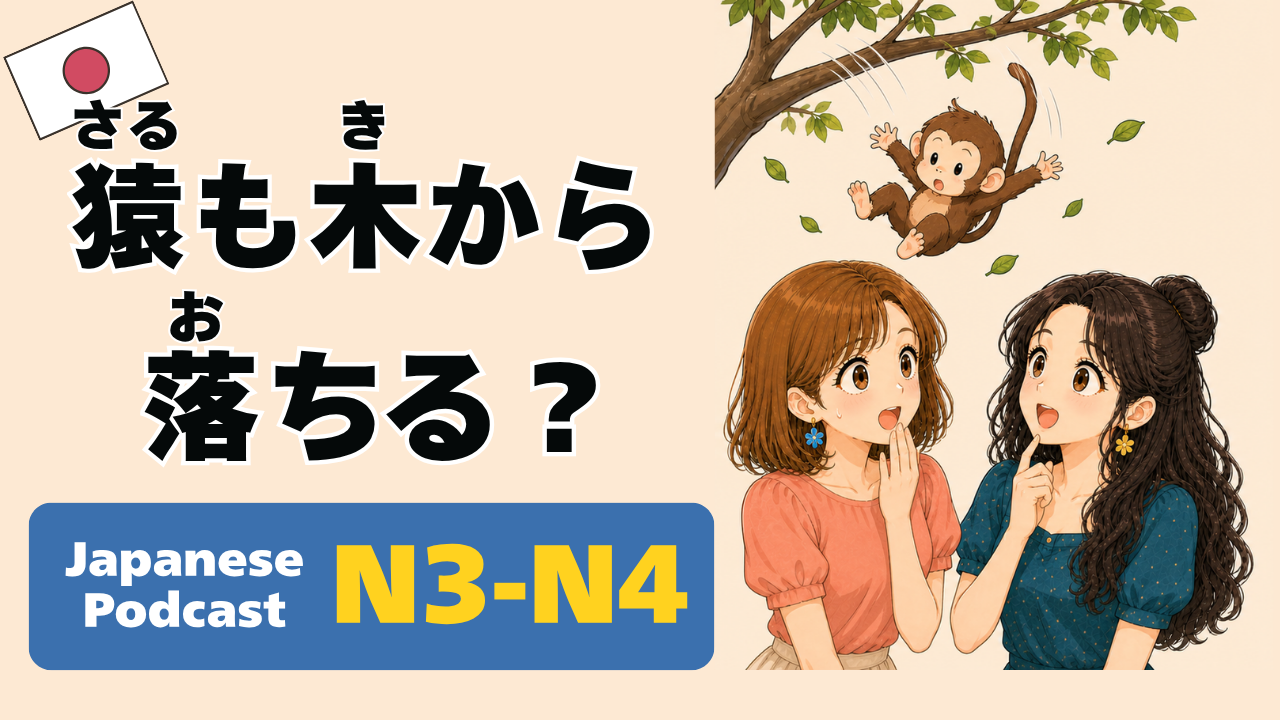
猿も木から落ちるCan Even Monkeys Fall from Trees?
Can even a monkey fall from a tree? Misaki and Nozomi explore the proverb 「猿も木から落ちる」, why the small word 「も」 matters, and how one mistake does not erase someone’s skill or experience. They also look at how to use the proverb kindly without sounding as if you are teasing someone.
What You’ll Learn
Learn what 猿も木から落ちる really means, how the particle も adds the sense of “even,” and why a single mistake should not erase someone’s experience. You’ll also learn when the proverb can sound encouraging—and when it can sound like teasing.
Transcript
A cooking teacher burned an omelet
1. 料理の先生が卵焼きを焦がした
A cooking teacher burned an omelet
Nozomi ミサキ、料理の先生が卵焼きを真っ黒に焦がした。
English: Misaki, a cooking teacher burned an omelet completely black.
Misaki 料理の先生なのに?
English: Even though they are a cooking teacher?
Nozomi 「こんな失敗は十年ぶり」って、自分で笑ってた。
English: The teacher laughed and said, “I have not made a mistake like this in ten years.”
Misaki それは「猿も木から落ちる」だね。
English: That is a perfect example of “even monkeys fall from trees.”
Nozomi 料理の先生は、猿じゃないよ?
English: The cooking teacher is not a monkey, though.
Misaki もちろん。木登りが上手な猿でも、時々は木から落ちます。
English: Of course. Even monkeys, which are good at climbing trees, sometimes fall.
Nozomi つまり、上手な人でも失敗する?
English: So it means that even skilled people make mistakes?
Misaki そう。今日は、このことわざの意味と「も」の働きを話します。そして使う時の注意も見ていきます。
English: Right. Today, we will discuss the proverb’s meaning and how “mo” works. We will also see what to be careful about when using it.
Nozomi 失敗した人を、猿と呼んでもいいの?
English: Is it okay to call someone who failed a monkey?
Misaki そこも、今日はっきりさせよう。
English: Let’s clear that up today too.
Misaki ということで始まりました、Late Night Japanese Chat。
English: And with that, welcome to Late Night Japanese Chat.
Misaki 私たち、ミサキと…
English: We are Misaki and…
Nozomi ノゾミがお届けします。今夜も楽しく話していきましょう。
English: Nozomi. Let’s enjoy another conversation tonight.
Why does the monkey fall?
2. なぜ猿が木から落ちるの?
Why does the monkey fall?
Nozomi まず、言葉どおりに見てみよう。「猿」は monkey。
English: First, let’s look at the words literally. “Saru” means monkey.
Misaki 「木から落ちる」は、木の上から下へ落ちること。
English: “Ki kara ochiru” means to fall down from a tree.
Nozomi 猿は、木登りが得意だよね。
English: Monkeys are good at climbing trees, right?
Misaki うん。手や足を上手に使って、木の間を動きます。
English: Yes. They use their hands and feet skillfully to move among trees.
Nozomi でも、そんな猿でも足を滑らせることがある。
English: But even such a monkey can sometimes slip.
Misaki そこが、このことわざの大事なところ。苦手な猿が落ちた話ではありません。
English: That is the important point. This is not a story about a monkey that is bad at climbing.
Nozomi 上手だからこそ、落ちた時に驚くんだね。
English: Because the monkey is skilled, we are surprised when it falls.
Misaki そう。人にも同じことがあります。
English: Exactly. The same thing happens to people.
Nozomi 料理人が料理を焦がす。先生が漢字を間違える。
English: A cook burns food. A teacher writes a kanji incorrectly.
Misaki いつもできる人にも、うまくできない日がある。それが「猿も木から落ちる」です。
English: Even people who usually succeed have days when things go wrong. That is “even monkeys fall from trees.”
The important word is “mo”
3. 大事なのは「も」
The important word is “mo”
Misaki ここで、今日のミニ解説です。大事なのは「も」。
English: Here is today’s mini lesson. The important word is “mo.”
Nozomi 「猿が木から落ちる」ではないんだね。
English: So it is not simply “a monkey falls from a tree.”
Misaki 「が」なら、猿が落ちたという普通の出来事です。
English: With “ga,” it is simply the ordinary fact that a monkey fell.
Nozomi 「猿も」なら、「猿でさえ」という驚きが入る。
English: With “saru mo,” it carries the surprise of “even a monkey.”
Misaki その通り。「先生も間違える」「日本人も漢字を忘れる」と同じです。
English: Exactly. It is like saying, “Even teachers make mistakes,” or, “Even Japanese people forget kanji.”
Nozomi 日本人は、漢字を全部覚えていると思われやすいよね。
English: People often think Japanese people remember every kanji.
Misaki でも、読めても書けない漢字はあります。
English: But there are kanji we can read and still cannot write.
Nozomi そんな時に「日本人も忘れるよ」と言われると、少し安心する。
English: Hearing “even Japanese people forget” can make you feel a little relieved.
Misaki 「も」は上手な人と自分を、同じ人間として近づけてくれることもあるね。
English: “Mo” can bring skilled people and ourselves closer together as fellow human beings.
Nozomi 小さな一文字だけど、大きな安心が入ってる。
English: It is one small character, but it can carry a lot of reassurance.
Failing at something you do well
4. 得意なことでも失敗する
Failing at something you do well
Nozomi 私、前に日本語の先生が黒板の漢字を間違えたのを見たことがある。
English: I once saw a Japanese teacher write the wrong kanji on the board.
Misaki 先生は、どうしたの?
English: What did the teacher do?
Nozomi 「あ、違う」と言ってすぐ自分で直した。
English: The teacher said, “Oh, that is wrong,” and corrected it immediately.
Misaki それだけで終わったの?
English: Was that all that happened?
Nozomi うん。私のほうが、「先生も間違えるんだ」って驚いた。
English: Yes. I was the surprised one, thinking, “Even teachers make mistakes.”
Misaki 得意なことは、絶対に失敗しないことではないからね。
English: Being good at something does not mean never making a mistake.
Nozomi 何度もやっているから、失敗に早く気づけるのかも。
English: Maybe doing something many times helps you notice mistakes quickly.
Misaki そう。上手な人は、失敗を隠す人ではありません。
English: Right. A skilled person is not someone who hides every mistake.
Nozomi 気づいて直し、次へ進める人。
English: They notice it, fix it, and move forward.
Misaki 一回の失敗で、それまでの経験が消えるわけではないよ。
English: One mistake does not erase all the experience that came before it.
Nozomi 卵焼きを焦がしても、料理の先生は先生のまま。
English: Even after burning an omelet, a cooking teacher is still a cooking teacher.
Does the proverb encourage people?
5. 失敗した人を励ます言葉?
Does the proverb encourage people?
Nozomi じゃあ失敗した人に「猿も木から落ちる」って言えば、励ませる?
English: Then can we encourage someone who failed by saying, “Even monkeys fall from trees”?
Misaki 場合によるね。優しい声なら、「誰にでも失敗はあるよ」という意味になります。
English: It depends. In a kind voice, it can mean, “Everyone makes mistakes.”
Nozomi でも、笑いながら言うと?
English: But what if you say it while laughing?
Misaki からかっているように聞こえることもあります。
English: It may sound as if you are making fun of them.
Nozomi 「プロなのに失敗したの? 猿も木から落ちるねえ」。
English: “You are a professional and still failed? Well, even monkeys fall from trees.”
Misaki その言い方は、ちょっと嫌だね。
English: That way of saying it feels unpleasant.
Nozomi ことわざが悪いんじゃなくて、声と関係の問題か。
English: So the proverb is not the problem. The tone and relationship matter.
Misaki そう。相手が本当に落ち込んでいたら、まず「大丈夫?」がいいと思う。
English: Exactly. If someone is truly upset, it is better to first ask, “Are you okay?”
Nozomi そのあとで、「誰にでもあるよ」と伝える。
English: Then you can tell them, “It happens to everyone.”
Misaki ことわざは相手を小さくするためではなく、心を軽くするために使いたいね。
English: We should use the proverb to lighten someone’s heart, not to make them feel small.
One mistake does not define you
6. 一回の失敗で全部を決めない
One mistake does not define you
Misaki このことわざは、自分に使うこともできます。
English: You can also use this proverb for yourself.
Nozomi 自分を猿だと思うの?
English: Do you think of yourself as a monkey?
Misaki そうではなくて、失敗を大きくしすぎないためです。
English: No. It is a way to keep a mistake from feeling too enormous.
Nozomi 得意な仕事で間違えると、「私はもう下手になった」って思うことがある。
English: When we make a mistake at something we are good at, we may think, “I am bad at this now.”
Misaki でも一回の失敗は、全部の評価ではありません。
English: But one mistake is not a judgment of everything you can do.
Nozomi 今日の失敗と、今まで積んだ経験は別に考える。
English: We can separate today’s mistake from all the experience we have built.
Misaki 原因を一つ見つけて、次に変えればいい。
English: Find one cause and change something for next time.
Nozomi 卵焼きなら、「火が強すぎた」と気づく。
English: With an omelet, you might notice that the heat was too high.
Misaki そして、次は火を少し弱くする。
English: Then next time, you lower the heat a little.
Nozomi 「失敗した」から、「一つ分かった」に変わるね。
English: “I failed” turns into “I learned one thing.”
Preparation still matters
7. 失敗しても準備は必要
Preparation still matters
Nozomi でも「上手な人でも失敗する」なら、準備しなくてもいい?
English: But if even skilled people make mistakes, does that mean we do not need to prepare?
Misaki それは違うよ。このことわざは、失敗の言い訳ではありません。
English: That is different. This proverb is not an excuse for mistakes.
Nozomi 「猿も落ちるから、確認しません」はダメ?
English: So “monkeys fall too, so I will not check” is no good?
Misaki むしろ、上手な人ほど基本を確認します。
English: In fact, skilled people often check the basics carefully.
Nozomi 料理人も火を見る。先生も書いた字を見直す。
English: A cook watches the heat. A teacher checks what they wrote.
Misaki それでも起きた失敗を、必要以上に責めない。それが大切です。
English: And when a mistake still happens, it is important not to blame someone more than necessary.
Nozomi 準備はする。でも、完璧な人はいない。
English: We prepare, but no one is perfect.
Misaki そうだね。失敗したら原因を見る。そして、またやってみる。
English: Exactly. When you fail, look at the cause and try again.
Nozomi 木から落ちたら、そこで木登りをやめる必要はないんだね。
English: Falling from a tree does not mean you have to stop climbing forever.
Misaki 安全を確かめて、また登ればいい。
English: You can check that it is safe and climb again.
Even skilled people have bad days
8. 上手な人にも失敗する日はある
Even skilled people have bad days
Misaki では、今日の三つのポイントをまとめよう。
English: Let’s summarize today’s three points.
Nozomi 一つ目。「猿も木から落ちる」は、上手な人でも失敗するという意味。
English: First, “even monkeys fall from trees” means that skilled people also make mistakes.
Misaki 二つ目。大事なのは「も」。「猿でさえ」という驚きを表します。
English: Second, the important word is “mo.” It expresses the surprise of “even a monkey.”
Nozomi 三つ目。人に言う時は、からかう声にならないように注意する。
English: Third, when saying it to someone, be careful not to sound as if you are teasing them.
Nozomi ちなみに、先生の二回目の卵焼きはきれいだったよ。
English: By the way, the teacher’s second omelet was beautiful.
Misaki 落ちても、すぐ木に登り直したんだね。
English: Even after falling, the teacher quickly climbed the tree again.
Misaki みなさんは、得意なことで失敗したことがありますか?
English: Have you ever made a mistake at something you are good at?
Nozomi 今夜も聞いてくれて、ありがとうございました。
English: Thank you for listening tonight.
Misaki この番組が、あなたの日本語の「居場所」の一つになれたら嬉しいです。
English: We would love for this show to become one of your “ibasho” — a place you belong — on your Japanese journey.
Nozomi よかったらチャンネル登録して、また帰ってきてね。
English: If you would like, subscribe and come back again.
Misaki また次回お会いしましょう。おやすみなさい。
English: See you next time. Good night.
Nozomi おやすみなさい。
English: Good night.
Vocabulary
Each word includes the original line from the transcript and one extra example. Use “See in transcript” to jump back to the conversation.
猿も木から落ちるeven experts make mistakes
FROM THE TRANSCRIPT
それは「猿も木から落ちる」だね。
EXAMPLE
いつも道に詳しい友達が迷ったので、「猿も木から落ちるね」と笑いました。
My friend who always knows the way got lost, so I joked, “Even experts make mistakes.”
得意being good at something; one’s strong point
FROM THE TRANSCRIPT
猿は、木登りが得意だよね。
EXAMPLE
私は、人の顔を覚えるのが得意です。
I’m good at remembering people’s faces.
苦手not being good at something; finding something difficult
FROM THE TRANSCRIPT
苦手な猿が落ちた話ではありません。
EXAMPLE
電話で予約するのが少し苦手なので、いつも緊張します。
I’m a little bad at making reservations by phone, so I always get nervous.
失敗mistake; failure
FROM THE TRANSCRIPT
つまり、上手な人でも失敗する?
EXAMPLE
新しいレシピは一回失敗したけど、次はうまくできました。
I failed the new recipe once, but it went well the next time.
励ますto encourage; to cheer someone up
FROM THE TRANSCRIPT
じゃあ失敗した人に「猿も木から落ちる」って言えば、励ませる?
EXAMPLE
試験に落ちて元気がない友達を、みんなで励ましました。
We all encouraged our friend who was feeling down after failing an exam.
Cultural Notes
猿も木から落ちる is about skilled people, not beginners. The surprise comes from the fact that monkeys are associated with being good at climbing. The proverb points out that even someone experienced can still make a mistake.
The particle も is essential. 猿が木から落ちる simply describes a monkey falling. 猿も木から落ちる adds the idea of “even a monkey,” which creates the proverb’s sense of surprise.
Tone matters when you use this proverb with another person. Said gently, it can mean “Everyone makes mistakes.” Said with a teasing tone, it may feel sarcastic. If someone is genuinely upset, showing concern first is often kinder.
Haru’s Note
I like the way this proverb separates one mistake from a person’s whole ability. A bad moment does not suddenly erase everything someone has learned or practiced.
得意なことでも、うまくいかない日はあります。一回の失敗だけで「もうだめだ」と決めるのではなく、ひとつ原因を見つけて、また次へ進む。そんなふうにこのことわざを使えたら、少し心が軽くなる気がします。



コメント