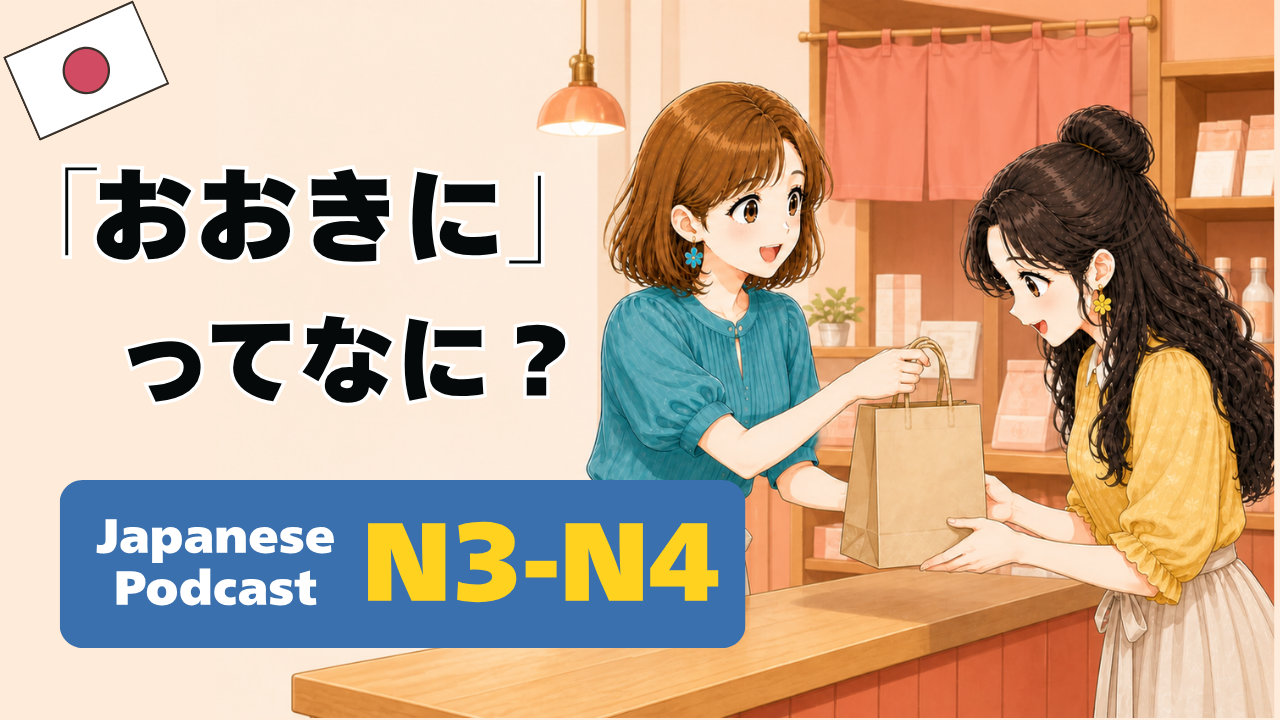
「ありがとう」だけじゃないHow Do Japanese Really Say Thank You?
Japanese people do not always say 「ありがとう」 when they want to thank someone. In this episode, Misaki and Nozomi explore 「おおきに」, 「どうも」, 「サンキュー」, and other everyday expressions, along with a simple pronunciation tip for more natural Japanese.
What You’ll Learn
Learn why おおきに is related to 大いに, how どうも can work as a casual thank-you or as part of a more polite expression, and how どうぞ differs from どうも. You’ll also learn how common thank-you expressions change with the situation and how long vowels affect natural pronunciation.
Transcript
Does “ookini” mean thank you?
1. 「おおきに」って、ありがとう?
Does “ookini” mean thank you?
Misaki ノゾミ。この前、大阪のお店で「おおきに」って言われたんだ。
English: Nozomi, the other day, someone at a shop in Osaka said “ookini” to me.
Nozomi 「おおきに」って、「ありがとう」だよね? 同じ日本語なのに、言葉が全然違うね。
English: “Ookini” means “thank you,” right? They are both Japanese, but the words sound completely different.
Misaki そう。それに「おおきに」は、「大きい」に少し似ていると思わない?
English: Right. And does “ookini” not sound a little like “ookii,” meaning “big”?
Nozomi じゃあ「おおきに」は、大きい「ありがとう」?
English: Then is “ookini” a big “thank you”?
Misaki 惜しい! 実は、まったく関係がないわけではないんだよ。
English: Close! Actually, they are not completely unrelated.
Nozomi えっ! 冗談のつもりだったのに、当たった?
English: What? I meant it as a joke, but was I right?
Misaki 今日は、日本人が使う「ありがとう」の仲間を見ていきます。話すのは「おおきに」の由来と「どうも」の不思議。そして、場面に合う言い方の三つです。
English: Today, we will look at Japanese expressions related to “thank you”: where “ookini” comes from, the mystery of “doumo,” and how to choose the right expression for each situation.
Misaki ということで始まりました、Late Night Japanese Chat。
English: And with that, welcome to Late Night Japanese Chat.
Misaki 私たち、ミサキと…
English: We are Misaki and…
Nozomi ノゾミがお届けします。今夜も楽しく話していきましょう。
English: Nozomi. Let’s enjoy another conversation tonight.
Are “ookii” and “ookini” related?
2. 「大きい」と「おおきに」は親戚?
Are “ookii” and “ookini” related?
Misaki まず「大きい」と「おおきに」の関係から見てみよう。
English: First, let’s look at the connection between “ookii” and “ookini.”
Nozomi 本当に親戚なの? 顔が少し似ているだけじゃなくて?
English: Are they really relatives? Do they only look a little alike?
Misaki 昔の日本語には「大きなり」という言葉がありました。そこから「大きに」という形も使われたんだ。
English: In older Japanese, there was a word, “ookinari.” The form “ookini” was also used from that word.
Nozomi その「大きに」は、今の「大きい」という意味?
English: Did that “ookini” mean “big,” like the modern word “ookii”?
Misaki 物の大きさより、「大いに」や「とても」に近い使い方です。「大いに感謝します」の「大いに」と同じ仲間だね。
English: Rather than physical size, it was used more like “greatly” or “very.” It belongs to the same word family as “ooini” in “I greatly appreciate it.”
Nozomi じゃあ昔は、「とてもありがとう」みたいな形だったの?
English: So long ago, was it something like “very, thank you”?
Misaki そう考えると分かりやすいよ。「大きいありがとう」は冗談だけど、方向は意外と近かったね。
English: That is an easy way to understand it. “A big thank you” was a joke, but the idea was surprisingly close.
Nozomi 今日の私、言葉の探偵になれるかもしれない。
English: I might be able to become a word detective today.
How “ookini” became a thank-you
3. 後ろの言葉が消えて「おおきに」だけ残った
How “ookini” became a thank-you
Misaki 昔は「おおきにありがとう」や「おおきにかたじけない」のような言い方がありました。
English: In the past, people used phrases such as “ookini arigatou” and “ookini katajikenai.”
Nozomi 「おおきに」は、後ろの感謝の言葉を強くしていたんだね。
English: So “ookini” strengthened the expression of gratitude that followed it.
Misaki そう。後ろの部分が少しずつ省略され、「おおきに」だけでも感謝が伝わるようになったと考えられています。
English: Right. The later part was gradually omitted, and “ookini” itself came to express thanks.
Nozomi 「ありがとう」が隠れているんだ。言葉のかくれんぼみたい。
English: So “arigatou” is hiding inside it. It is like a game of hide-and-seek with words.
Misaki 今は特に関西で聞く言葉です。お店で「おおきに」と言われると、地域の言葉を感じます。
English: Today, it is heard especially in the Kansai region. Hearing “ookini” in a shop gives you a sense of the local language.
Nozomi 日本のどこでも、みんなが毎日使うわけではない?
English: So it is not something everyone uses every day all across Japan?
Misaki うん。自分から無理に使わなくても大丈夫。まずは「関西のありがとうだ」と分かれば十分だよ。
English: Right. You do not need to force yourself to use it. It is enough to recognize it as a Kansai way of saying thanks.
Nozomi 大阪に着いた瞬間、全部「おおきに」に変えなくていいんだね。
English: So I do not need to change every “thank you” to “ookini” the moment I arrive in Osaka.
The hidden words behind “doumo”
4. 「どうも」にも隠れた言葉がある
The hidden words behind “doumo”
Misaki 次は「どうも」。これも、後ろの言葉が隠れることがあります。
English: Next is “doumo.” This word can also hide what comes after it.
Nozomi 「どうもありがとう」の「ありがとう」が消えて、「どうも」だけになる?
English: Does the “arigatou” in “doumo arigatou” disappear, leaving only “doumo”?
Misaki その通り。「どうも」は、もともと気持ちの強さを表す言葉です。「本当に」や「とても」に近い働きをすることがあります。
English: Exactly. “Doumo” originally expresses the strength of a feeling. It can work like “really” or “very.”
Nozomi 「どうもありがとう」なら、「本当にありがとう」に近いんだ。
English: So “doumo arigatou” is close to “thank you very much.”
Misaki そう。でも「どうも」だけだと、短くて軽いお礼として使われます。
English: Yes. But “doumo” by itself is used as a brief, casual thank-you.
Nozomi 「どうもありがとうございます」は丁寧なのに、「どうも」だけなら軽い。少しややこしいね。
English: “Doumo arigatou gozaimasu” is polite, but “doumo” alone is casual. That is a little confusing.
Misaki 丁寧さは、後ろに続く言葉で変わると考えるといいよ。「どうも」は感謝を強くし、「ございます」が丁寧さを作ります。
English: It helps to think that politeness changes according to what follows. “Doumo” strengthens the gratitude, while “gozaimasu” creates the politeness.
Nozomi 短い「どうも」の後ろにも、見えない「ありがとう」がいるんだね。
English: So even after the short “doumo,” there is an invisible “arigatou.”
“Douzo” vs. “doumo”
5. 渡す人は「どうぞ」、受け取る人は「どうも」
“Douzo” vs. “doumo”
Misaki ここで、よく似た「どうぞ」と「どうも」を場面で比べてみよう。
English: Now, let’s compare the similar-sounding “douzo” and “doumo” in a situation.
Nozomi 最後の一文字だけ違うから、聞くと一瞬迷うことがあるね。
English: Only the final sound is different, so they can be confusing for a moment when you hear them.
Misaki 私がノゾミにお菓子を渡します。「はい、どうぞ」。
English: I hand Nozomi a snack and say, “Here you go, douzo.”
Nozomi 私は受け取って、「どうも」。
English: I receive it and say, “Thanks, doumo.”
Misaki 「どうぞ」は、相手に何かを差し出す時の言葉です。
English: “Douzo” is used when offering something to another person.
Nozomi 「どうも」は、相手から受け取った時の短いお礼。
English: “Doumo” is a short thank-you when receiving something from another person.
Misaki 矢印で覚えると簡単です。「どうぞ」は自分から相手へ。「どうも」は相手から受け取る。
English: It is easy to remember with arrows. “Douzo” goes from you to the other person. With “doumo,” you receive from them.
Nozomi 入口で道を譲る人は「どうぞ」。先に通る人は「どうも」と言えるね。
English: At an entrance, the person giving way can say “douzo,” and the person going through first can say “doumo.”
Nozomi じゃあ、お菓子を渡しながら「どうも」と言ったら?
English: Then what if I say “doumo” while handing over the snack?
Misaki お礼なのか、お菓子なのか。少し迷わせるかも。
English: You might leave them wondering whether you are offering thanks or the snack.
Thank-you expressions for each situation
6. 「ありがとう」は場面で着替える
Thank-you expressions for each situation
Misaki 「ありがとう」の仲間は、相手との関係や場面によって変わります。
English: Expressions related to “thank you” change depending on the relationship and situation.
Nozomi 「ありがとう」が、場面に合わせて服を着替えるみたいだね。
English: It is like “arigatou” changes clothes to match the situation.
Misaki 丁寧なのは「ありがとうございます」。初めて会う人や仕事の場面でも使いやすいです。
English: “Arigatou gozaimasu” is polite and easy to use with someone you have just met or in a work setting.
Nozomi 友達や家族なら「ありがとう」。メッセージでは「ありがと」と短くすることもある。
English: With friends and family, you can say “arigatou.” In messages, it is also shortened to “arigato.”
Misaki 「サンキュー」はさらに軽くて、親しい相手との会話で使います。
English: “Sankyuu” is even more casual and is used in conversations with people you are close to.
Nozomi 「あざす」や「あざっす」も聞くよね。最初は、何の言葉か分からないかも。
English: You also hear “azasu” and “azassu.” At first, it may be hard to tell what word they came from.
Misaki これは「ありがとうございます」が大きく短くなった、とてもくだけた言い方。目上の人や丁寧な場面では避けたほうが安全です。
English: These are very casual forms created by greatly shortening “arigatou gozaimasu.” It is safer to avoid them with superiors or in polite situations.
Nozomi 迷った時は、「ありがとうございます」を着れば大丈夫だね。
English: When in doubt, you can safely dress your thanks in “arigatou gozaimasu.”
A natural pronunciation tip
7. 「う」は一つずつ読まない?
A natural pronunciation tip
Misaki 最後に、自然に聞こえる発音の小さなコツです。
English: Finally, here is a small pronunciation tip to help you sound natural.
Nozomi 「どうも」と「ありがとう」には、どちらも「う」が書いてあるね。
English: Both “doumo” and “arigatou” have the letter “u” in their Japanese spelling.
Misaki でも「ど・う・も」と、一文字ずつ分けて読むわけではありません。「どう」は「どお」、つまり長い「お」の音です。
English: But we do not pronounce “do-u-mo” one character at a time. “Dou” sounds like “doo,” with a long “o” sound.
Nozomi 「どおも」。最初の「お」を少し伸ばす感じだね。
English: “Doomo.” It feels like slightly lengthening the first “o.”
Misaki 「ありがとう」の最後も「と・う」と分けず、「とお」に近い長い音になります。
English: At the end of “arigatou,” we also do not separate “to” and “u.” It becomes a long sound closer to “too.”
Nozomi 「ありがとお」。書く時は「ありがとう」だけど、聞こえる音は「ありがとお」に近い。
English: “Arigatoo.” It is written “arigatou,” but the sound you hear is closer to “arigatoo.”
Misaki 「う」が消えたのではありません。前の「お」と一緒になって、長い音を作ると覚えてね。
English: Remember that the “u” has not disappeared. It joins the previous “o” to create a long sound.
Nozomi 「どーもー」と伸ばしすぎると、急に芸人の挨拶みたいになるから注意だね。
English: But if you stretch it too much into “dooomooo,” it suddenly sounds like a comedian’s greeting, so be careful.
Which thank-you would you choose?
8. あなたなら、どの「ありがとう」を選ぶ?
Which thank-you would you choose?
Misaki では場面を見ながら、今日の三つをまとめよう。
English: Let’s review today’s three points through a few situations.
Nozomi 関西のお店で「おおきに」と聞こえたら、隠れている「ありがとう」を見つけた合図。
English: If you hear “ookini” in a Kansai shop, it is a sign that you found the hidden “arigatou.”
Misaki 一つ目。「おおきに」は、昔の「大いに」に近い言葉から生まれました。
English: First, “ookini” came from an older word close to the modern “ooini,” meaning “greatly.”
Nozomi 二つ目。「どうも」だけでも、短いお礼になる。
English: Second, “doumo” by itself can be a short thank-you.
Misaki 三つ目。迷ったら「ありがとうございます」が、いちばん安全です。
English: Third, when in doubt, “arigatou gozaimasu” is the safest choice.
Nozomi 今日は、「ありがとう」が何回も着替えたね。
English: Today, “arigatou” changed clothes many times.
Misaki 次に「どうも」を聞いたら、後ろに隠れた「ありがとう」を思い出してみてください。
English: The next time you hear “doumo,” try remembering the hidden “arigatou” behind it.
Nozomi 見えない「ありがとう」を探すゲームだね。
English: It is a game of finding invisible thank-yous.
Misaki 今夜も最後まで聞いてくれて、ありがとうございました。
English: Thank you for listening all the way to the end tonight.
Nozomi 日本語には、まだまだ小さな「なんで?」が隠れています。
English: Japanese still has many little “whys” hiding inside it.
Misaki 次回も、一緒に日本語の謎を見つけていきましょう。
English: Next time, let’s discover another Japanese mystery together.
Nozomi よかったらチャンネル登録をして、次のおしゃべりにも遊びに来てね。
English: If you would like, subscribe and join us for our next chat.
Misaki それでは、また次の夜に。おやすみなさい。
English: Until the next night. Good night.
Nozomi おやすみなさい。
English: Good night.
Vocabulary
Each word includes the original line from the transcript and one extra example. Use “See in transcript” to jump back to the conversation.
おおきにthank you; a Kansai expression of gratitude
FROM THE TRANSCRIPT
ノゾミ。この前、大阪のお店で「おおきに」って言われたんだ。
EXAMPLE
京都の市場で買い物をしたら、店員さんが「おおきに」と言ってくれました。
When I shopped at a market in Kyoto, the shopkeeper said “ookini” to me.
大いにgreatly; very much
FROM THE TRANSCRIPT
「大いに感謝します」の「大いに」と同じ仲間だね。
EXAMPLE
新しい企画には大いに期待しています。
I have very high expectations for the new project.
どうもthanks; very much
FROM THE TRANSCRIPT
そう。でも「どうも」だけだと、短くて軽いお礼として使われます。
EXAMPLE
荷物を持ってくれた友達に、「どうも」と軽くお礼を言いました。
I gave my friend a quick “doumo” for helping carry my bag.
どうぞhere you go; please; go ahead
FROM THE TRANSCRIPT
私がノゾミにお菓子を渡します。「はい、どうぞ」。
EXAMPLE
この席、空いていますよ。どうぞ。
This seat is free. Please, go ahead.
省略omission; abbreviation
FROM THE TRANSCRIPT
後ろの部分が少しずつ省略され、「おおきに」だけでも感謝が伝わるようになったと考えられています。
EXAMPLE
長い会社名は、会話では省略して呼ぶことがあります。
Long company names are sometimes shortened in conversation.
Cultural Notes
おおきに is especially associated with Kansai today. Its history is connected to the older form 大きに, which carried a meaning close to “greatly” or “very much.” Over time, longer expressions of thanks could be shortened until おおきに itself expressed gratitude.
どうも changes depending on what comes after it. On its own, it can be a brief and casual thank-you. In どうもありがとうございます, the full expression is much more polite.
Casual thank-you expressions are not interchangeable in every situation. サンキュー, あざす, and あざっす can sound very relaxed. When you are unsure what level of politeness is appropriate, ありがとうございます is the safer choice.
Haru’s Note
One thing I like about thank-you expressions in Japanese is how much information they can carry beyond simple gratitude. The same basic feeling can sound local, casual, playful, or polite depending on the words you choose.
「ありがとう」だけを覚えても、もちろん十分です。でも、「おおきに」や「どうも」を聞いたときに、「これも感謝の言葉なんだ」と分かると、日本語の会話がもう少し立体的に聞こえてくるかもしれません。


コメント