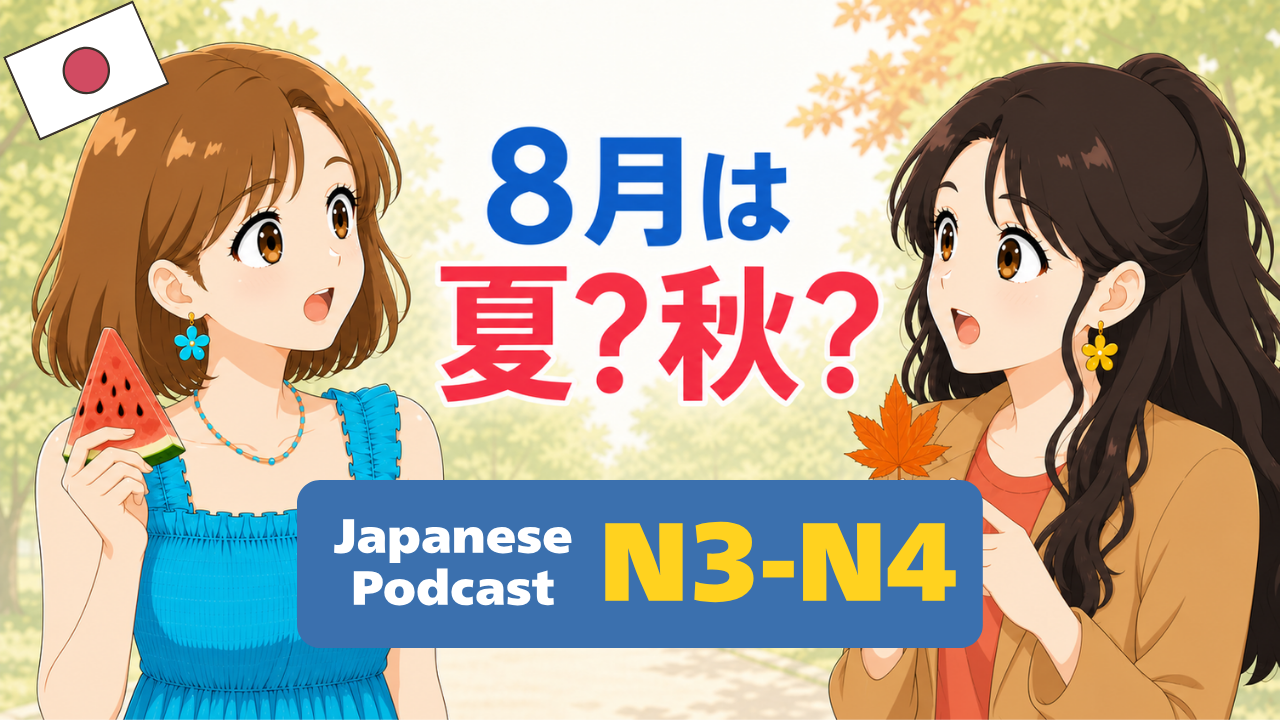
「残暑」ってなに?Is August Summer or Autumn?
Is August summer or autumn in Japan? Misaki and Nozomi explore the traditional calendar, the seasonal marker 「立秋」, and the meaning of 「残暑」—the heat that lingers after autumn has officially begun on the calendar.
What You’ll Learn
Learn why August can be described as both summer and autumn in Japan, what 暦, 立秋, and 残暑 mean, and how seasonal greetings change after risshuu. You’ll also see the useful grammar pattern 〜のに in a natural summer conversation.
Transcript
Is it summer or autumn?
1. 今は夏? それとも秋?
Is it summer or autumn?
Misaki ノゾミ、クイズです。今は夏? 秋?
English: Nozomi, here is a quiz. Is it summer or autumn now?
Nozomi え? もちろん夏でしょ。八月だよ。今日も暑いし。
English: What? Of course it is summer. It is August, and it is hot today too.
Misaki 違います。正解は、秋です。
English: Incorrect. The answer is autumn.
Nozomi 秋!? どこに? 見えないんだけど。
English: Autumn!? Where? I cannot see it.
Misaki ごめん。「暦の上では」秋です。
English: Sorry. It is autumn according to the traditional calendar.
Nozomi 大事な言葉を、あとから足したね。
English: You added the important part afterward.
Misaki 「暦」は、日にちや季節の区切りを決めるカレンダーの考え方です。
English: Koyomi is a calendar system for marking dates and seasonal divisions.
Nozomi 私のスマホに入っているカレンダーとは違うの?
English: Is it different from the calendar on my phone?
Misaki 予定を書くカレンダーじゃないよ。太陽の動きに合わせて、季節を分ける考え方です。
English: It is not a calendar for writing appointments. It divides the seasons according to the movement of the sun.
Nozomi じゃあ、気温を見て「今日から秋」と決めたわけじゃないんだ。
English: So it was not decided by checking the temperature and saying, “Autumn starts today.”
Misaki そう。暦は、天気予報ではありません。
English: Right. The traditional calendar is not a weather forecast.
Nozomi よかった。暦が暑さに鈍いのかと思った。
English: Good. I thought the calendar was bad at noticing heat.
Misaki 「暦」「残暑」「季節の挨拶」を話します。
English: We will discuss koyomi, zansho, and seasonal greetings.
Nozomi 暑さの居残りね。
English: Heat staying late. Got it.
Misaki ということで始まりました、Late Night Japanese Chat。
English: And with that, welcome to Late Night Japanese Chat.
Misaki 私たち、ミサキと…
English: We are Misaki and…
Nozomi ノゾミがお届けします。今夜も楽しく話していきましょう。
English: Nozomi. Let’s enjoy another conversation tonight.
What are koyomi and risshuu?
2. 暦と立秋ってなに?
What are koyomi and risshuu?
Misaki さっき出てきた「暦」を、もう少しだけ見てみよう。
English: Let’s take one more quick look at the word koyomi from earlier.
Nozomi 「もう少しだけ」なら安心。難しい話は、まだ暑いから入らないよ。
English: I am relieved to hear “just a little.” It is still too hot for difficult explanations.
Misaki 昔から日本では、一年を二十四の季節の目印に分けてきました。
English: Traditionally, Japan has divided the year into twenty-four seasonal markers.
Nozomi 二十四!? 春夏秋冬の四つじゃないの?
English: Twenty-four!? Are there not just four seasons: spring, summer, autumn, and winter?
Misaki 大きく分けると四つ。その中に、小さな季節の目印があるんだ。
English: There are four broad seasons. Inside them are smaller seasonal markers.
Nozomi 季節の途中に、小さな看板が立っている感じ?
English: Is it like small signposts standing along the way through each season?
Misaki そのイメージ、分かりやすいね。その一つが、毎年八月七日ごろの「立秋」です。
English: That is a helpful image. One of those markers is risshuu, around August 7 each year.
Nozomi 「秋が立つ」と書くんだね。
English: It is written with the characters for “autumn stands.”
Misaki ここでの「立つ」は、季節が始まるという意味。秋が完成する日ではありません。
English: Here, tatsu means a season begins. It is not the day autumn becomes complete.
Nozomi 秋のスタート地点なんだ。ゴールじゃないなら、まだ暑くても仕方ないね。
English: So it is autumn’s starting line. If it is not the finish line, the heat makes sense.
Can August be both?
3. 八月は夏? 秋? どっちも正解
Can August be both?
Misaki じゃあ、最初のクイズに戻ろう。八月は、本当に秋なのかな。
English: Let’s return to the first quiz. Is August really autumn?
Nozomi さっき私を不正解にした人が、それを聞くの?
English: Is the person who marked me wrong really asking that now?
Misaki 普通の生活では、八月は夏と考えて大丈夫。気象の区分でも、六月から八月は夏です。
English: In everyday life, it is fine to think of August as summer. In meteorology, June through August is also summer.
Nozomi よかった。私の夏は、まだ終わってなかった。
English: Good. My summer was not over after all.
Misaki でも、昔からの暦では立秋から秋。つまり、基準が違うんだよ。
English: But in the traditional calendar, autumn begins at risshuu. The standard is simply different.
Nozomi 天気で見れば夏。暦で見れば秋。どっちも正解なんだね。
English: By the weather, it is summer. By the traditional calendar, it is autumn. Both are correct.
Misaki そう。それに日本は南北に長いから、同じ日でも感じる季節が違います。
English: Exactly. Japan is also long from north to south, so the season can feel different on the same day.
Nozomi 北海道では、朝や夜に少し涼しい日もあるよ。
English: In Hokkaido, some mornings and evenings already feel a little cool.
Misaki 本州では、夜まで暑い日も多いよね。
English: On Honshu, many days stay hot even at night.
Nozomi 日本には、夏と秋が同時にいるんだ。
English: Summer and autumn can exist in Japan at the same time.
Zansho: heat working overtime
4. 「残暑」は暑さの居残り
Zansho: heat working overtime
Misaki ここで、今日の言葉を分解しよう。「残暑」です。
English: Now let’s break down today’s word: zansho.
Nozomi 「残」と「暑」。漢字が二つだね。
English: Zan and sho. It has two kanji.
Misaki 「残」は、「残る」の残。まだそこにあるという意味です。
English: Zan is the same character as nokoru, meaning to remain or still be there.
Nozomi 冷蔵庫に残っているプリンと同じ「残る」?
English: The same nokoru as pudding left in the refrigerator?
Misaki 同じです。「暑」は、暑さのこと。
English: The same one. Sho means heat.
Nozomi つまり「残暑」は、秋になっても残っている暑さ。
English: So zansho is heat that remains even after autumn begins.
Misaki その通り。立秋を過ぎたあとの暑さを表します。
English: Exactly. It describes the heat after risshuu.
Nozomi 暑さまで、夏から残業しているんだね。
English: Even the heat is working overtime after summer.
Misaki しかも、なかなか帰ってくれません。
English: And it refuses to go home.
Nozomi 「今年は残暑が長い」と言ったら、暑い日が長く続くということだね。
English: If we say, “This year’s zansho is long,” it means hot days continue for a long time.
Misaki 「残暑が厳しい」は、立秋のあとも暑さが強いという意味です。
English: “The zansho is severe” means the heat remains strong after risshuu.
Finding autumn inside summer
5. 夏の中に、小さな秋を探す
Finding autumn inside summer
Misaki 残暑の季節は、暑さだけを見ると夏みたいだよね。
English: During zansho, it still looks like summer if we only notice the heat.
Nozomi 昼は夏。太陽も、まだ元気すぎる。
English: Daytime is summer. The sun still has far too much energy.
Misaki でも朝の風や、日が沈む時間に小さな変化が出てきます。
English: But small changes begin to appear in the morning breeze and the time the sun sets.
Nozomi 北海道だと、夜の空気が急に冷たくなる日もあるよ。
English: In Hokkaido, the night air can suddenly feel cool on some days.
Misaki 日本人は、小さな変化を見つけて「秋らしくなったね」と話します。
English: Japanese people notice those small changes and say, “It is beginning to feel like autumn.”
Nozomi 暑い中でも、秋を探しているんだね。
English: So we look for autumn even while it is still hot.
Misaki 虫の声が変わったり、空が少し高く見えたりすることもあるね。
English: The insects may sound different, and the sky may seem a little higher.
Nozomi 昼はアイスを食べたいのに、夜は温かいお茶もいい。
English: I want ice cream during the day, but warm tea sounds good at night.
Misaki それが、夏と秋の間なのかもしれない。
English: That may be what the space between summer and autumn feels like.
Nozomi 季節も、一日で着替えないんだね。
English: Seasons do not change clothes in a single day either.
Misaki うん。少しずつ夏を脱いで、秋に着替えていきます。
English: Right. Summer is slowly taken off as the world changes into autumn.
Nozomi でも昼は、まだ夏の服を離さない。
English: But daytime still refuses to let go of its summer clothes.
Two seasonal greetings
6. 暑中見舞いと残暑見舞い
Two seasonal greetings
Misaki 日本には、この季節に送る「残暑見舞い」という挨拶があります。
English: Japan has a seasonal greeting called zansho mimai, sent during this time.
Nozomi 暑い時期に、相手の体調を気づかう手紙やカードだよね。
English: It is a letter or card sent during hot weather to ask after someone’s health.
Misaki そう。立秋より前は「暑中見舞い」。立秋を過ぎたら「残暑見舞い」です。
English: Right. Before risshuu, it is shochuu mimai. After risshuu, it is zansho mimai.
Nozomi 暑さが同じでも、立秋を越えると名前が変わるんだ。
English: Even if the heat is the same, the name changes after risshuu.
Misaki ここでも、実際の気温より暦が基準になります。
English: Here too, the traditional calendar matters more than the actual temperature.
Nozomi 暦、手紙の世界では強いね。
English: The traditional calendar is powerful in the world of letters.
Misaki 最初に「残暑お見舞い申し上げます」と書くことがあります。
English: The greeting may begin with “Zansho omimai moushiagemasu.”
Nozomi 少し丁寧だけど、意味は「まだ暑いですね。元気ですか?」に近いんだね。
English: It sounds formal, but it is close to saying, “It is still hot. How are you?”
Misaki そう考えると、やさしい季節の挨拶に聞こえるね。
English: When we think of it that way, it sounds like a kind seasonal greeting.
How to use noni
7. 「秋なのに暑い」の「のに」
How to use noni
Misaki 最後に、残暑の時期に使える会話を見てみよう。
English: Finally, let’s look at phrases you can use during zansho.
Nozomi いちばん簡単なのは、「まだ暑いですね」。
English: The simplest one is, “It is still hot, isn’t it?”
Misaki 「朝晩は涼しくなりましたね」も自然です。
English: “The mornings and evenings have become cooler” is also natural.
Nozomi 少し丁寧に言うなら、「残暑が厳しいですね」。
English: For a slightly more formal phrase, say, “The lingering heat is severe, isn’t it?”
Misaki そして今日にぴったりなのは、「暦の上では秋なのにまだ暑い」です。
English: And a perfect sentence for today is, “Even though it is autumn on the calendar, it is still hot.”
Nozomi この「のに」は、思っていたことと違う時に使うんだよね。
English: We use noni when something is different from what we expected, right?
Misaki そう。「秋なら涼しいはず。でも暑い」という驚きを表します。
English: Right. It expresses the surprise: “Autumn should be cool, but it is hot.”
Nozomi 「秋なのに、アイスを二個食べました」。
English: “Even though it is autumn, I ate two ice creams.”
Misaki それは、季節よりノゾミの問題かもしれない。
English: That may be more about you than the season.
Nozomi 残暑が厳しかったから、仕方ありません。
English: The lingering heat was severe, so it could not be helped.
Misaki 「のに」の使い方は、完璧です。
English: Your use of noni is perfect.
When summer and autumn meet
8. 夏と秋が一緒にいる季節
When summer and autumn meet
Misaki では、今日の三つをまとめよう。
English: Let’s review today’s three points.
Nozomi 一つ目。暦は、季節の区切りを決めるカレンダーの考え方。
English: First, koyomi is a calendar system that marks seasonal divisions.
Misaki 二つ目。毎年八月七日ごろの立秋から、暦の上では秋が始まります。
English: Second, autumn begins on the traditional calendar around risshuu, near August 7 each year.
Nozomi 三つ目。立秋のあとに残る暑さが「残暑」。暑さの居残りです。
English: Third, zansho is the heat that remains after risshuu. It is heat staying late.
Misaki じゃあ、もう一度聞きます。八月は夏? 秋?
English: Now I will ask again. Is August summer or autumn?
Nozomi 気象では夏。暦では秋。今度は、どっちも正解!
English: In meteorology, summer. On the traditional calendar, autumn. This time, both are correct!
Misaki 完璧です。夏と秋が一緒にいる季節なんだね。今夜も最後まで聞いてくれて、ありがとうございました。
English: Perfect. It is a season when summer and autumn are together. Thank you for listening all the way to the end tonight.
Nozomi 日本語の季節の言葉を知ると、同じ空も少し違って見えますね。
English: Learning Japanese seasonal words can make the same sky look a little different.
Misaki 次回も、一緒に日本語の小さな「なんで?」を見つけていきましょう。
English: Next time, let’s discover another small “why” in Japanese together.
Nozomi よかったらチャンネル登録をして、次のおしゃべりにも遊びに来てね。
English: If you would like, subscribe and join us for our next chat.
Misaki それでは、また次の夜に。おやすみなさい。
English: Until the next night. Good night.
Nozomi おやすみなさい。
English: Good night.
Vocabulary
Each word includes the original line from the transcript and one extra example. Use “See in transcript” to jump back to the conversation.
暦calendar; traditional calendar system
FROM THE TRANSCRIPT
「暦」は、日にちや季節の区切りを決めるカレンダーの考え方です。
EXAMPLE
祖母の家には、昔の暦が今も大切に残っています。
An old traditional calendar is still carefully kept at my grandmother’s house.
立秋beginning of autumn on the traditional calendar
FROM THE TRANSCRIPT
その一つが、毎年八月七日ごろの「立秋」です。
EXAMPLE
ニュースで「今日は立秋です」と聞いて、もうそんな時期かと思いました。
I heard on the news that today was risshuu and thought, “Is it already that time of year?”
残暑lingering summer heat
FROM THE TRANSCRIPT
ここで、今日の言葉を分解しよう。「残暑」です。
EXAMPLE
九月になっても残暑が続き、毎日エアコンを使っています。
The lingering summer heat continued into September, so I’m still using the air conditioner every day.
残暑見舞いlate-summer seasonal greeting
FROM THE TRANSCRIPT
日本には、この季節に送る「残暑見舞い」という挨拶があります。
EXAMPLE
久しぶりの友達に、短い残暑見舞いのカードを送りました。
I sent a short late-summer greeting card to a friend I hadn’t spoken to in a while.
厳しいsevere; intense; harsh
FROM THE TRANSCRIPT
「残暑が厳しい」は、立秋のあとも暑さが強いという意味です。
EXAMPLE
今年の冬は寒さが厳しく、朝の散歩が大変です。
The cold is severe this winter, so morning walks are tough.
Cultural Notes
立秋 is a seasonal marker, not a weather forecast. It falls around August 7 each year and marks the beginning of autumn in the traditional calendar. That does not mean the weather suddenly becomes cool on that day.
August can be both “summer” and “autumn,” depending on the system you use. In Japan’s meteorological seasons, June through August is summer. In the traditional calendar, autumn begins at 立秋.
Seasonal greetings also follow the calendar. Before 立秋, a summer greeting may be called 暑中見舞い. After 立秋, the expression changes to 残暑見舞い, even if the temperature still feels just as hot.
Haru’s Note
I like how the word 残暑 makes the season feel less like a switch and more like a transition. Summer does not disappear in one day; the heat can remain while small signs of autumn begin to show up.
季節は、ある日に急に変わるものではありません。昼はまだ暑くても、朝の風や夕方の空に、ほんの少し次の季節が見える。「残暑」は、そんな季節の途中を感じさせる言葉だと思います。



コメント